
Transparency and accountability in government are important factors in ensuring robust and inclusive economic growth and fostering public trust in institutions. A year after President Ferdinand “Bongbong” Marcos, Jr.’s May 2022 elections victory, there is a need to step back and assess what the government has done to ensure that these core democratic values are upheld.
There was a general acceptance of the May 2022 national election results. The voter turnout of 84.1% or 55,290,821 voters who actually voted[1] was a testament to the public’s trust in our democratic system and their commitment to make their voices heard.
Moreover, as part of his administration’s initiatives towards upholding transparency and accountability, President Marcos, Jr. enumerated priority bills in the sectors of finance and information and communications technology (ICT) in his first State of the Nation Address. Some of the most notable ones are the E-Government and E-Governance Bills, which streamline government services through digitization, as well as the Budget Modernization Bill, which institutionalizes cash-based budgeting. As of today, the E-Governance Act under House Bill 7327 has been approved on third reading by the House of Representatives and is still pending under the Senate, while the Budget Modernization Bills are pending in both Houses.
While there is public consensus on the need for these reforms, the Marcos, Jr. Administration must be keen on the inclusivity of its reform programs to show that such are democratically beneficial. Another concern is perhaps the effectiveness of such reforms in bringing back public trust in government.
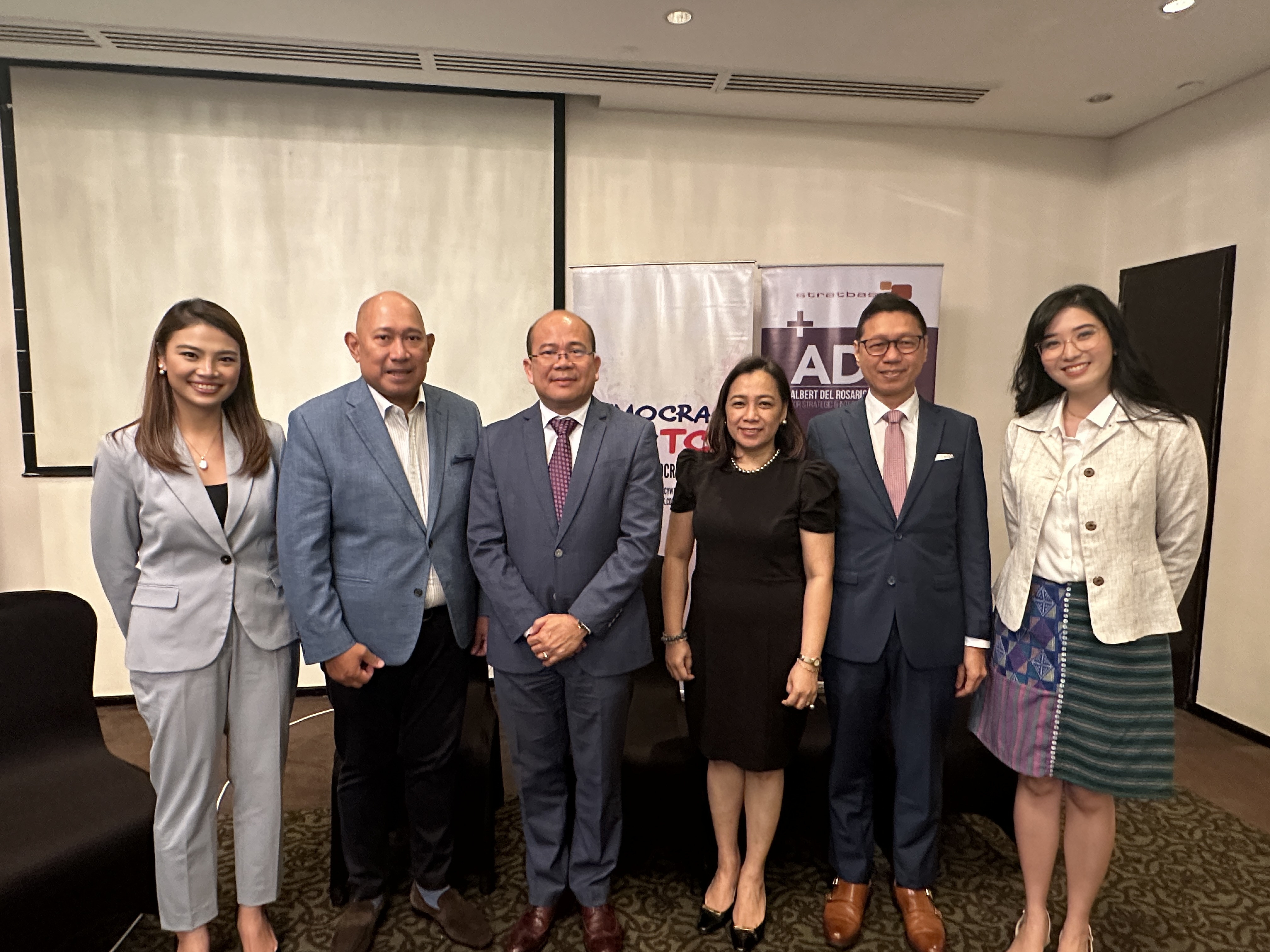
In this light, the Stratbase ADR Institute, in partnership with Democracy Watch Philippines, will be organizing a hybrid event entitled, “The Legitimacy of President Marcos, Jr.: Entailing the Need for More Transparent and Accountable Governance”.This will be held on 30 June 2023, Friday, from 9:00 AM – 11:00 AM (PHT) at Joy Ballroom I, 5/F Joy~Nostalg Hotel & Suites Manila, Ortigas Center, Pasig City, and live-streamed via Zoom.
The discussion aims to bring together key figures and their corresponding assessments of the state of transparency and accountability in Philippine governance and electoral systems, current good governance initiatives of the Marcos Jr. administration, and how well these fare in terms of restoring public and private sector trust.
[1] Commission on Elections (COMELEC). (2023, May 27). Election Results. Republic of the Philippines Commission on Elections. https://comelec.gov.ph/?r=2022NLE/ElectionResults_
Program
Safeguarding Democracy: Securing a Legitimate 2022 Elections and Achieving Greater Transparency and Accountability in Government
Prof. Victor Andres “Dindo” Manhit
President, Stratbase ADR Institute
Ensuring Transparency and Accountability through Budget Modernization
Hon. Rolando Toledo
Assistant Secretary, Local Government and Regional Operations Group,
Department of Budget and Management (DBM)
Open Government as a Catalyst for Transparency
Dr. Francisco Magno
Trustee and Program Convenor, Stratbase ADR Institute;
Senior Fellow, La Salle Institute of Governance;
Professor of Political Science and Development Studies, De La Salle University – Manila
Recentering Power Dynamics for Sustainable Economic Growth
Dr. Philip Randy Tuaño
Dean, Ateneo School of Government
Moving Forward: Recommendations to Strengthen Transparency and Accountability in Government
Dr. Lizan Perante-Calina
Dean, Development Academy of the Philippines-Graduate School of Public and Development Management
A Year After: An Assessment of President Marcos, Jr. Government’s Transparency and Accountability Initiatives
Ms. Mashan Bernice “Shanice” Espiritu
Policy and Regulatory Manager, Stratbase ADR Institute
Host & Moderator:
Ms. Mary Joyce Ilas
Communications and Advocacy Lead, Stratbase ADR Institue
 Stratbase Institute