

Seated (L to R): H.E. Lai Thai Binh (Ambassador, Embassy of Vietnam in the Philippines), H.E. MaryKay Carlson (Ambassador, Embassy of the United States in the Philippines), H.E. Shri Harsh Kumar Jain (Ambassador, Embassy of India in the Philippines), H.E. Lee Sang Hwa (Ambassador, Embassy of the Republic of Korea in the Philippines), H.E. Marie Fontanel (Ambassador, Embassy of France in the Philippines), Prof. Victor Andres “Dindo” Manhit (President, Stratbase Institute), H.E. HK Yu PSM, FCPA (Aust) (Ambassador, Australian Embassy in the Philippines), H.E. David Hartman (Ambassador, Embassy of Canada in the Philippines), H.E. Andreas Michael Pfaffernoschke (Ambassador, Embassy of the Federal Republic of Germany in the Philippines), H.E. Massimo Santoro (Ambassador, Embassy of Delegation of the European Union in the Philippines), and H.E. Endo Kazuya (Ambassador, Embassy of Japan in the Philippines)
Standing (L to R): H.E. Yuliia Fediv (Ambassador, Embassy of Ukraine in the Philippines), H.E. Răduţa Dana Matache (Ambassador, Embassy of Romania in the Philippines), H.E. Marielle Geraedts (Ambassador, Embassy of the Netherlands in the Philippines), H.E. Emma Hickey (Ambassador, Embassy of the Ireland in the Philippines), Mr. Geir Michaelsen (Deputy Chief of Mission, Embassy of Norway in the Philippines), H.E. Michel Parys (Ambassador, Embassy of Belgium in the Philippines), Ms. Stacey Kwant (Deputy Head of Mission, Embassy of New Zealand in the Philippines), H.E. Saija Nurminen (Ambassador, Embassy of Finland in the Philippines), H.E. Karel Hejč (Ambassador, Embassy of the Czech Republic in the Philippines), H.E. Franz-Michael Skjold Mellbin (Ambassador, Embassy of Denmark in the Philippines), Mr. Máté Kiss (Deputy Chief of Mission, Embassy of Hungary in the Philippines), H.E. Smiljana Knez (Ambassador, Embassy of Slovenia in the Philippines), Mr. Sebastian Kunze (Attaché, Embassy of Austria in the Philippines), Mr. Danilo Dovgoborets (Deputy Chief of Mission, Embassy of Sweden in the Philippines), Mr. Giovanni Porcu (Deputy Head of Mission, Embassy of Italy in the Philippines), and Group Captain Bea Walcot (Representative of H.E. Laure Beaufils – Ambassador, British Embassy in the Philippines)
To mark the ninth anniversary of the 2016 Arbitral Award, the Stratbase Institute hosted its international conference, “9th Year of the Arbitral Victory: Defending the Rules-Based Order through Reinforced Defense Capabilities and Partnerships,” on July 11, 2025.
The event brought together leaders from government, the diplomatic corps, academe, and civil society in a united affirmation of the 2016 Arbitral Award and the enduring value of a rules-based international order. Ambassadors and representatives from 26 like-minded nations attended the conference, reflecting strong and growing global support for the Philippines and the rule of law.
Stratbase will continue promoting stronger partnerships among stakeholders because, together, we send a clear message: aggression will not go unchecked, and international rules must be upheld – by all, for all.
Remarks of Australian Ambassador H.E. HK Yu PSM, FCPA (Aust): Strengthening Cooperation under the Philippine-Australia Strategic Partnership
This is the third year I have had the honor of speaking in this important forum. And it will also be my last time—sadly as my posting as Australian Ambassador to the Philippines will soon come to an end. I have thoroughly enjoyed my time as Ambassador and learned so much about Filipino people and this beautiful country.
The bilateral relationship between Australia and the Philippines has really undergone a major uplift over the last three years. The elevation to the strategic partnership in September 2023 underscores the strength and dynamism of our deep and long-lasting relationship. We very much look forward to celebrating the 80th anniversary of our diplomatic relations next year. So not too bad, 80 years we’ve been friends and partners, and I think it’s fantastic.
Colleagues, over the last three years our shared ambition for a peaceful, prosperous and stable region has brought the Philippines and Australia even closer together. And I’m sure many of you can feel that and see that and that has meant that we have really stepped up our cooperation on all fronts from development, trade and investment, to cyber and critical technology, countering interference and many more. We are demonstrating a strategic partnership in action.
But as we gather today to acknowledge yet another anniversary of the landmark 2016 Arbitral Award, I would like to focus my remarks on Australia’s relationship with the Philippines in the area of maritime security.
Each time I speak to forums like this, I wish I could describe the South China Sea as a place of peace, stability and prosperity. A place where disputes are able to be resolved peacefully in accordance with international law, particularly the UNCLOS. A place where the 2016 Arbitral Award is acknowledged as final and binding on the parties, where states acknowledge that the rule of law and being a good international citizen mean they cannot simply choose whether or not to abide by rulings they dislike.
Sadly, however, we continue to see destabilizing conduct in the South China Sea, as well as excessive maritime claims that are inconsistent with UNCLOS and the Arbitral Award. The Philippines has continued to face these incidents over even the last six months, including sideswiping and water cannoning of civilian vessels. Australia too has experienced unsafe and unprofessional conduct, recently, including involving a Royal Australian Air Force PAA aircraft.
This is why it is critically important that all states uphold UNCLOS to maintain peace, security and stability in the region. Australia has shown steadfast support to the Philippines and other Southeast Asian partners in upholding international law, particularly UNCLOS, and we will continue to do so. Australia stands for rules and for a resilient region that can exercise agency, our own agency.
We are, for example, working together with the Philippines and other Southeast Asian states to enhance their maritime security capabilities. Doing this is critically important for Australia. Indeed, one of the first things my Prime Minister Albanese, said after the recent election was strengthening our relationships in our region.
Today, I wish to highlight the depth and breadth of our partnership to the Philippines through three key tangible ways. We are helping the Philippines uphold the rules-based order. One, our long-standing defense ties and cooperation. Two, our civil maritime cooperation. And finally, cyber cooperation.
First, on our long-standing defense ties and cooperation, Australia and the Philippines have historic defense ties dating back to the Second World War, a friendship that has endured in both good times and in bad. When General McArthur came ashore in Leyte in 1944, he did so in the company of Australian Defense Force personnel. Australians stood, flew, sailed, and fought alongside our Filipino comrades between 1942 until liberation in 1945. Since then, Australia and the Philippines have fought and operated side by side in the Korean War and in Vietnam, Cambodia, Timor-Leste, and Iraq.
In 2013, Australia responded to Typhoon Yolanda, delivering medical and logistic support to devastated areas of the Philippines. And in 2017, the Australian Defence Force assisted operations to combat radical Islamic terrorism in Marawi City. Until recently, we were the only country other than the US that actually had a visiting forces agreement with the Philippines.
But even this very deep relationship, as you can see, has been evolving over the last three years, and for a very good reason. We are regularly now undertaking maritime cooperative activities in the South China Sea, with the Philippines and other partners. We recently undertook our sixth MCA on the 29th of April with the Philippines and the US.
And not only are we completing more MCAs, they are also becoming more complex in nature—as they should. This is set to continue.
Recently, Defense Ministers from Australia, Japan, the Philippines, and the US committed to expand engagement by like-minded partners in MCAs. And next month, I’m going to miss this, and I’m really sad about it, but our largest bilateral joint exercise ever, Exercise Alon will return to the Philippines. It will be the Australian Defense Force’s largest exercise outside Australia this year. Our partners, Canada and the United States, will also participate as we work together to support regional security and stability.
Australia participated in Exercise Balikatan this year across Palawan and Luzon as well. Our participation demonstrated our commitment to security and stability and engagement in the Indo-Pacific region. We also welcomed Philippine fighter aircraft participating in exercise Pitch Black in Australia last year, another first in our bilateral relationship.
Did you know that this was the first time Philippine Air Force assets had been deployed outside the Philippines since 1963? So, we are kicking some goals. It is clear our defense relationship is at an historic high, grounded in a shared commitment to supporting a peaceful, stable, and prosperous region. We must remain steadfast in our defense of international law and the rules-based order that is the lifeblood of our way of life.
But defending the rules-based order, international order, doesn’t stop just at a strong defense relationship. These efforts are reinforced by our extensive program of civil maritime cooperation, which has grown enormously in recent years, including under our MOU on enhanced maritime cooperation.
Under Australia’s Southeast Asia maritime partnerships, we are providing support for maritime education and operational training, including postgraduate scholarships. Law of the Sea training and strategic analysis courses for the Philippine maritime agencies have also been provided. We also have activities underway for vessel remediation, combatting illegal fishing, and marine environmental protection. In addition, we’ve been listening closely to our Philippine partners to understand how we can best help meet the Philippines’ specific needs.
That’s why I was so pleased to donate 20 world-class aerial drones, operator training, and communications equipment to the PCG earlier this year. These are helping the PCG advance their capability around maritime domain awareness. And last year we also donated 21 VHF base radios to the PCG and are currently procuring additional communications equipment. These donations are already having a real-world impact. I was so pleased to hear that in April, three of our donated drones were used in a search and rescue operation after a vessel capsized, an excellent example of our strategic partnership in action.
As many of you will know, our bilateral civil maritime program has partnered with the Philippines for many years to strengthen maritime governance arrangements, build institutional capacity, and promote discussion and analysis of maritime issues.
Late last year, I was delighted to announce that starting this year, and I think it was in one of these events by Stratbase, that we are doubling our commitment with the Philippines under this program to PHP 649 million over the coming years. And it is my great pleasure to announce today for the first time that over the next couple of years, Australia will provide PCG with additional drones and other uncrewed maritime domain awareness technologies worth around PHP 110 million. So you’re the first one to hear this, it hasn’t been announced until today.
But our commitment goes further than just physical assets. It will include operational training, support, and an integration package. This capability uplift is another example of Australia’s ongoing commitment to provide tangible assistance to the Philippines to boost its maritime domain awareness.
These examples demonstrate Australia’s steadfast commitment to work with the Philippines and our other Southeast Asian partners in practical ways to improve our collective maritime capabilities, uphold international law, and contribute to the security and prosperity of the region. And finally, very quickly, in our effort, I want to cover this, in our effort to defend the international rules-based order, we are also looking to the new threats and challenges we are all facing. Through my department’s Southeast Asia and Pacific Cyber program, we are stepping up cyber capacity building support to the Philippines as a priority partner country.
The PCG is not just on the front line in the Philippines oceans, but also in the country’s cyberspace. Australia is committed to supporting the PCG, the Philippine National Police, and various other departments as they work to boost their capabilities to mitigate and respond to cyber incidents.
This year, we delivered already tailored cyber incident response training and simulated exercises to strengthen PCG’s instant incident response capabilities, a cyber threat intelligence assessment, and a roadmap for system hardening and uplift.
And I’m particularly excited about this new line of work. These activities have strengthened PCG’s capacity to prevent and respond to cyber security incidents, helping our partner build cyber resilience that will in turn help to achieve maritime security. These are real, tangible, practical things that are happening as we speak, to ensure that both Australia and the Philippines grow more cyber resilient in this ever-changing, evolving security and strategic environment.
In conclusion, serving as Australia’s ambassador to the Philippines has been a true honor. And I’m so proud of the work we have done over the last three years to enhance maritime security cooperation between our two countries. I’m certain that our strategic partnership will continue to go from strength to strength as we continue to work together to stand up to the order, to work hard for our people, so we can create a better future for all our citizens, where we can ensure that there is peace, stability, and prosperity for all.
Thank you very much for being here today. And with that, maraming, maraming, salamat po. Mabuhay!
Remarks of British Ambassador H.E. Laure Beaufils: Enhanced Partnership under the Philippines-UK Joint Framework
This is, of course, a very important and timely conference. For the UK, it comes on the back of our Strategic Defense Review and our new National Security Strategy, a holistic and integrated approach to enhancing the UK’s national security.
It also follows a historic NATO summit where, alongside our allies, we delivered a commitment to spend 5% of our GDP on national security by 2035, the largest sustained investment in our armed forces since the Cold War. The reason for this historic commitment is clear. As our National Security Strategy states, we are entering an era of radical uncertainty, characterized by intensification of great power competition, volatility, authoritarian aggression, and greater exposure to shocks and technological change.
The only way we can protect ourselves against the risks related to this is by investing in our collective security. Collective security will remain the foundation of our strategy to deter and to defend against aggression. As the Strategic Defense Review sets out, the UK will take a NATO-first approach, but certainly not a NATO-only approach.
This means that we remain as ever committed to our partners and allies across the world, recognizing that our security is so closely connected. As such, the Middle East and Indo-Pacific are priority regions for the UK. The need to focus on upholding stability in the Indo-Pacific is clear.
Our National Security Strategy underlines the centrality of the South China Sea and the Taiwan Strait to global trade and supply chains. It is estimated, as you know, that over $5 trillion worth of global trade traverses the South China Sea annually, representing about a third of global maritime trade. Maintaining stability in this region is vital for our collective security and prosperity.
And what happens here matters for stability in the rest of the world as well. We continue to abide by the important principle shared by many of you that the security of the Euro-Atlantic and Indo-Pacific regions are inextricably linked. If we allow international rules and principles, such as freedom of navigation, to be undermined in the Indo-Pacific, then we only embolden malign actors to undermine them elsewhere. And, of course, vice versa.
So, our direction is clear. The UK will proudly and confidently play our part to support a free and open Indo-Pacific and a free and open South China Sea. The UK will uphold the rules-based international system by promoting our strength abroad. We will bolster collective security by renewing and deepening our partnerships and alliances and developing new relationships in new domains. The Philippines is a key partner for the UK in the Indo-Pacific.
During my four years here, I have had the great pleasure of seeing the relationship between our two countries broaden and deepen through our close and warm engagement, but also our strategic and ambitious vision, our shared values, and a mutual respect for the rules-based international system. The UK Foreign Secretary reiterated this when he came to Manila in March. Together with then-Foreign Secretary Manalo, they signed a joint framework for the UK-Philippines Enhanced Partnership, a roadmap which sets out the breadth of the UK-Philippines relationship and how we will cooperate to deliver on our shared priorities.
This sets out that the UK will continue to strengthen our cooperation with the Philippines in foreign policy, maritime security, and defense to promote a stable and peaceful international order based on international law. We are proud to be offering our expertise in areas such as crisis response, maritime domain awareness, illegal, unregulated, and unreported fishing, and tackling environmental damage to coastal areas through our own world-renowned agencies, such as the Royal Navy’s MDA team and the UK’s Hydrographic Office. And we’ve worked closely with the Philippines on strategic communications, supported Filipinos to take part in global training on international law of the sea, brought together regional states to cooperate on maritime security issues through our Regional Maritime Security Symposium.
These and many other priorities continue to feature in our Maritime Dialogue, the third iteration of which will take place in September this year. In the defense space, we are building military capability through the provision of international defense training, focusing on developing specialist skills and professional military education for future commanders. We are pursuing joint military exercise and capitalizing on opportunities to partake in other military exercises.
We are particularly pleased to have become a Balikatan partner nation this year. We are increasing bilateral engagement across the air, land, and maritime domains, with periodic visits by Royal Navy ships, visits and engagements by defense leaders and specialist training teams. The planned visit of an asset from a carrier strike group to Manila in just a few months exemplifies our growing defense cooperation.
Operation Highmast, our carrier strike group deployment, is a demonstration of the UK’s commitment to the Indo-Pacific and our resolve to uphold the rules-based international system. There is no doubt that we face challenges in upholding international law, right around the world and right here in this region. An open, rules-based international order remains the foundation that the global order rests upon. I like to call it the scaffolding that holds our world together. It is a critical tool for enhancing our shared security and prosperity. It resists the pronouncement that might is right, that ends justify any means.
Excellencies, the 2016 Arbitral Award was an important moment for UNCLOS and international law. The UK would like to once again underline that the Arbitral Award is binding on the Philippines and China, despite protests about its legitimacy from the latter. We will continue to advocate for international law in the South China Sea and continue to oppose and call out actions that raise tensions or the risk of miscalculation.
We do not do this just through words, but also through our actions. We have continued to exercise our rights and freedoms under UNCLOS in the South China Sea this year, autonomously and in multilateral activity with our allies. And we are grateful to have a strong group of like-minded partners with us, particularly in calling out dangerous and escalatory behavior.
Our efforts are always more powerful when we act together in good company. I am delighted that the Philippine Circle of Friends is growing. New mini-lateral groups, new defense agreements, new security partnerships, these are key to supporting peace and stability through the region.
Collectively, we are helping to challenge excessive Chinese maritime claims and dangerous activities that raise the risk of escalation. Through the G7 and at the UN General Assembly, we have been pursuing initiatives to enhance and coordinate work with our partners on maritime security and upholding international law in the South China Sea. This is ultimately all about peace and stability.
Together, we are pulling in the same direction to uphold a free and open Indo-Pacific. Ladies and gentlemen, this will be one of my very last events, perhaps indeed the last public event after four years as an ambassador to the Philippines. The South China Sea, international law, maritime security have been such a central theme in my last four years.
And thus, it is quite fitting to close my time here with this conference today. The Philippines has been bold in their support of international law in the South China Sea. We applaud this and we salute the resolve shown by this administration.
UK, for our part, will always stand up for international law, including UNCLOS, of course. This is a cornerstone of our foreign policy. Through continuing to build strong partnerships and collaboration in support of international law, together, we can and will ensure a more stable, peaceful and prosperous future for us all.
Thank you very much. Maraming, maraming salamat po.
Remarks of Canadian Ambassador H.E. David Hartman: Future of Philippine-Canada Defense Cooperation under a Visiting Forces Agreement
Today, we mark a milestone. Nine years since the 2016 Arbitral Ruling, a moment in history when the Philippines, standing on the strength of international law, won a peaceful yet powerful victory. A ruling that reaffirmed what we already knew, that might does not make right, that the rights of nations, big or small, are equally protected under international law.
However, before I get to the heart of the subject matter this morning, I would like to reiterate what many of you know all too well, namely that Canada is consistent in stating that the 2016 Arbitral Tribunal ruling is both final and binding on the parties.
Moreover, Canada remains deeply concerned by China’s continued disregard of the ruling. Beijing’s actions, including the recent rash of harassing incidents involving the Philippine civilian maritime science and fisheries vessel, threatens regional peace and stability, and potentially, with global consequences.
This year, under Canada’s G7 presidency, we are working with our partners to draw attention to the importance of stability in the West Philippine Sea and the South China Sea, and to reject all forms of coercion.
The South China Sea hosts more than half the world’s fishing fleets, which are competing for increasingly scarce maritime resources, which millions of people depend upon for their livelihoods and for food security throughout the region. The destruction of marine habitats and the prevalence of illegal, unreported, and unregulated fishing, combined with complex security issues, are resulting in situations where security, biodiversity loss, and climate challenges are overlapping to aggravate and amplify one another. The Philippines must be able to exercise freedom of navigation, as well as enjoy the sovereign rights to which it is entitled, within its exclusive economic zone.
The Arbitral Award was not just a legal affirmation of the Philippines’ maritime entitlements under the United Nations Convention on the Law of the Sea. It was a declaration to the world that sovereign rights are not negotiable, that international law can remain a great equalizer in this often and increasingly unpredictable world. But if we are to preserve the legacy of this ruling, we must look beyond commemoration and instead commit ourselves to action.
Because in the face of evolving regional security dynamics, the rule of law must be backed by partnerships. And this is where both civilian and defense cooperation come into play. Not as a tool of confrontation, but as a means of reinforcing peace and stability, and the rule of law.
This is why, since October 2023, Canada’s Department of Fisheries and Oceans has been working closely with 16 agencies and departments of the Philippine government that have full access to our country’s powerful and world-class Dark Vessel Detection Program. This program, which utilizes multiple satellite missions, including Canada’s RADARSAT constellation, is helping to increase the Philippines’ maritime domain awareness in combat and illegal fishing operations. Last year, we also conducted our first Canada-Philippines high-seas fishery patrols, with the deployment of one of Canada’s Dash 8 aerial surveillance aircraft.
Another vital avenue for our cooperation that I would like to highlight is the future of Philippine-Canada defense relations and the emerging opportunity of our soon-to-be-signed and formalize Status of Visiting Forces agreement. Friends, as we know all too well, the Indo-Pacific region is dynamic, diverse, and it is increasingly contested, and it has emerged as a geopolitical center of gravity in the 21st century. Peace and prosperity go hand-in-hand. Maritime tensions and gray zone coercion threaten not just the peace of individual nations, but the integrity of the global system that underpins the freedom of navigation, open trade, and peaceful coexistence. Against this backdrop, defense partnerships are grounded in shared values that are not optional, they are essential. Canada and the Philippines are coastal Pacific nations which share deep commitment to the principles of the international order.
We believe in peaceful resolution of disputes, multilateralism, and a free and open Indo-Pacific. And I must emphasize that these are not just diplomatic concepts, they are security imperatives. The SOVFA between our two countries represents more than just the legal architecture; it is a strategic enabler.
It unlocks the potential of closer cooperation, operational interoperability, and readiness. And it provides a foundation for training, logistics, intelligence sharing, and more frequent, flexible military engagement. Let me now just outline a few of the several key areas of this agreement that will bring to the fore in the coming months and into years ahead.
First, enhanced joint exercises and operations. These will see the Philippines and Canada increase participation in bilateral and multilateral exercises. Exercises such as Balikatan and Sama-Sama, Kamandag, and as well as humanitarian assistance, disaster response, and maritime security operations.
These activities will benefit not only our armed forces but also develop the resilience and preparedness of our communities. Second item is the augmented Canadian presence and access in a critical theater of operation that will see the Canadian Armed Forces, particularly through the Royal Canadian Navy and the Royal Canadian Air Force, more easily deploy air and naval assets in support of air and maritime domain operations with ships and aircraft that will support intelligence and surveillance and reconnaissance missions in the South China Sea and the West Philippine Seas.
Under a ratified SOVFA, these deployments will become more frequent, more responsive, and more effective when personnel and assets are staged from the Philippines, rather from distant bases farther afield. An enhanced and persistent deployment of Canadian Air Force personnel in the Philippines will also bring our two nations into closer operational rhythm, improving interoperability, accelerating response times, and demonstrating presence in a region where it matters most. We have so much to learn and share from each other.
Our SOVFA will also permit specialized training, most notably in maritime security cooperation, for small and specialized units. These will include cyber, civil-military cooperation, explosive ordnance disposal training, and vessel boarding, search and rescue, and seizure operations. These are capabilities that the Canadian Air Force needs to excel and also are essential tools for upholding the rule of law at sea and responding to transnational threats.
The final item will be logistics and operational sustainability. As the Philippines pursues its vision of becoming a logistic hub for partner nations, a SOVFA with Canada will facilitate port visits, repairs, resupply, and ammunition replenishment. Canadian naval vessels will make short-notice support calls, conduct maintenance and restore critical supplies to ensure readiness in a region where time and access are strategic commodities.
But friends, let me be clear — defense cooperation is not about preparing for war. It is about preparing for peace and ensuring that peace endures.
By deepening our military engagement under a SOVFA framework, we are not just improving capabilities. We are investing in deterrence. We are reinforcing the architecture of mutual respect and sending a signal that the international order is alive, it is defended, and it is being actively shaped by countries that believe in fairness, legality, and peaceful coexistence.
Canada’s Indo-Pacific strategy commits to peace, resilience, and security in the region. It is a supporting respect for international law. Combined with the Philippines’ enduring commitment to maritime rights, we find natural alignment in this particular endeavor.
Canada and the Philippines are increasingly close allies and our neighbors in the Pacific Ocean who share our enduring commitment to share values and interests. As we reflect today on the 9th anniversary of the 2016 Arbitral Award, we must not see this as a milestone, as an end point, but as a foundation. A victory in international law only remains meaningful if it is defended in practice and strengthened through cooperation.
Let us recognize that partnerships, especially amongst democracies, are our greatest strategic asset. And let us move forward purposefully for the future where our Philippine-Canada SOVFA is a cornerstone of our shared security and architecture.
Because, my friends, in a world that should be tied in uncertain ways, we do not stand alone. We stand together in defense of law, in pursuit of peace, and in commitments to one another. Maraming salamat po and thank you very much. And may our partnership continue to grow in strength, depth, and resolve.
Remarks of European Delegation Ambassador H.E. Massimo Santoro: From Maritime to Cybersecurity: the Philippines-EU Evolving Cooperation
At the very beginning, when I was sharing with some friends and colleagues in the very start, only the presence, looking at the presence of today, that would be enough to confirm the level and intensity of the support the Philippines has from the international community and from the friends of the rules-based international order. And then, listening to the very good and meaningful interventions of colleagues before, that was an even more in-depth witness of the intensity of this partnership.
The topic of our discussion, indeed, is the 2016 Arbitral Award on the South China Sea. Yet, the award’s significance invites a larger reflection about how the preeminence of the international law and adherence to certain values unites the international community. Certainly, the European Union and the Philippines share the belief on legal means to solve international disputes and strong commitments to the international rule of law anywhere in the world.
On the West Philippine Sea and the South China Sea, we have underscored in each and every occasion that all disputes should be settled by peaceful means, without the threat or even the use of force or cohesion in accordance with international law. The European Union has also consistently reaffirmed the importance of maritime safety and maritime security, freedom of navigation, freedom of overflight and other lawful uses of the seas in accordance with UNCLOS. We do support the ongoing negotiations for a Code of Conduct in the South China Sea.
The position of the European Union has consistently been that the future Code of Conduct should be effective, should be legally binding and should be in line with UNCLOS and not prejudice the interests of third countries. In any situation or dispute, our compass is very clear. The UN Charter, the International Human Rights and the International Humanitarian Treaties, the UNCLOS, these are the legal framework on which anything must happen.
This is valid in Europe, this is valid in Asia, elsewhere, and this is also valid in all sectors, including cyberspace. This is why the European Union is announcing its security cooperation with the Philippines and with many other partners in Asia and in the world. This is more in particular one of the pillars of the European Union’s strategy towards the Indo-Pacific and the EU maritime strategy.
The Indo-Pacific and maritime security are essential for the EU’s interests. Sometimes I’m asked why we are so involved into the issue of the South China Sea. Even taking aside the element of the value, which is the respect of the international rules-based order, which in itself should be a reason, more concretely, within the wider region, the South China Sea is of a very specific importance to the European Union.
A large part of the EU foreign trade, it’s about 38%, so it’s about 40% of imports and 22% of EU exports goes through the South China Sea. Any conflict in the Indo-Pacific and, of course, in the South China Sea, would have far-reaching consequences for the EU economy and for EU security.
Just a few weeks ago, our high representative and vice-president of the European Commission, Kaja Kallas, as you know, was here on the 1st and 2nd of June. She had very important meetings and together with the Former Secretary of Foreign Affairs Enrique Manalo, they announced the establishment of a new EU-Philippines security and defense dialogue. The dialogue addresses the current geopolitical challenges. It will foster exchanges and cooperation in security and defense areas, including maritime security, cyber security, hybrid threats, foreign information manipulation and interference (FIMI).
This will be a very dedicated platform through which we will deepen even further our cooperation. We will exchange expertise on security and defense, and we’ll be exploring together joint initiatives that can operationally contribute to the regional as well as global security.
The first meeting of the security and defense dialogue is tentatively set to take place in the last quarter of this year, 2025. We’re now working together with our Philippine friends to identify the concrete and specific dates together. This new dialogue will add, of course, to the existing cooperation frameworks because it will bring in joint work on areas responding to emerging challenges like cyber and FIMI. It also works in tandem with our other regional and global programs in which the European Union is also supporting the Philippines and other international partners, including ASEAN, in the areas that I just mentioned as well as other areas like countering terrorism and violent extremism, peacekeeping, disaster risk reduction, preparedness, non-proliferation.
Important for all of us to have in mind that everything is interlinked. All sectors are interlinked and all the areas of cooperation are interlinked. While being considered as a non-traditional security partner for the Philippines due to its geographical distance, the European Union is not a new security actor in the Philippines.
The EU engagement with the Philippines, as you know, including on security, goes back two decades. I am in particular referring to our support for the peace process in Mindanao, in which the EU continues to be very much engaged. Our support for the peace process is comprehensive and targets the political settlement and socio-economic recovery of conflict-afflicted areas.
Cooperation projects amounting to a total of EUR 140 million are currently ongoing in Mindanao. As I mentioned before, everything is interlinked. I think it is important to recall this because the more peaceful and stable internal security we have in the Philippines, the more this can create the conditions that allow the Philippines government to rebalance the resources devoted to internal security towards facing external security threats and external security risks.
The Philippines, positioned in the heart of the vital global sea lanes, plays a critical role in regional maritime security. Therefore, our cooperation in the maritime area is for the EU of particular strategic importance. It goes well beyond just the maritime domain and interlinks with other areas, including the economy, including the blue economy, energy, transport, supply chains, tourism, access to and conservation of maritime, marine, natural resources, critical infrastructures, including offshore and underwater infrastructures.
The Critical Maritime Routes in the Pacific, it’s called CRIMARIO as we all know, represents the core of the EU operational contribution to enhancing maritime situational awareness, notably through the IORIS platform, which is a secure communication channel for regional partners that coordinate responses to maritime incidents. IORIS is helping with improved inter-agency coordination and for various IUUs cases including illegal, unreported and unregulated fishing. It’s used to detect dark targets, to deter drug trafficking and to prevent piracy and armed robberies at sea.
Philippine maritime agencies have also received extensive training on CRIMARIO as IORIS platform since 2022 and its use has harmonized inter-agency information flows, promoted collaboration and trust and enhanced interoperability amongst one another. It is currently used by 12 different Philippine maritime agencies.
And then the Philippines has also recently become a partner within the EU enhancing security cooperation in and with Asia and the Indo-Pacific, it’s the famous ESIWA initiative, a regional initiative that supports cooperation with partners in Asia and the Indo-Pacific on maritime security, counter-terrorism, crisis management and peacekeeping, cyber security, hybrid threats, foreign information manipulation and interference.
In the region, ESIWA has organized activities on topics like unmanned underwater vehicles, sanctions enforcement at sea and just last week here in Manila we have had an excellent event on coordination and cooperation with the DFA, an event on the protection of critical infrastructure. Critical infrastructure is essential for global communication, for economic security and is vulnerable to attacks both in the EU and in the Philippines. We are also examining other means or tools that will support the Philippines in its efforts to reinforce its defense capabilities notably in terms of technical capabilities and equipment.
Let me stress that this enhanced security cooperation and engagement of the European Union with the Philippines in the wider region does not intend to be a threat to any country, nor it is addressed against any country. Everyone benefits from a world that is more stable and more peaceful where disputes are resolved according to the legal principles that have been agreed by all. Moving forward to the new EU-Philippine security and defense dialogue, we will pave the way for more joint initiatives contributing to regional stability.
We will also continue our engagement within the ASEAN regional forum and with ASEAN and ASEAN countries of course. The EU and ASEAN have an important role to play in supporting a rules-based international order and multilateralism, as well as regional international security and stability. I appreciate very much, like colleagues before me, the intervention in the words of Secretary Lazaro just some minutes ago.
I am confident that the Philippines’ chairmanship will be an excellent occasion in ASEAN for developing this engagement. As a reliable, predictable and valuable rules-based partner, the European Union can also bring much at the table of the East Asia Summit and the ASEAN Defense Ministers’ Meeting Plus. This cooperation at the EU level is of course as it is always the case, in full synergy with an increased bilateral cooperation and engagement with our member states and between our member states and the Philippines and other Indo-Pacific partners including enhanced naval presence by the EU member states assets in the Indo-Pacific, as well as increasing participation in military exercises in the region including in the Philippines.
My dear colleagues, today after me, I am pretty sure we will develop on these important aspects. Dear friends, dear colleagues, thank you very much for your attention. I am very much looking forward to having an engaging and fruitful discussion.
Maraming salamat sa inyo lahat. Thanks a lot.
Remarks of French Ambassador H.E. Marie Fontanel: Enhancing Security Partnerships Among Maritime Nations through the French-Philippine Visiting Forces Agreement
Let me start by conveying my condolences to the Filipino people, thinking of the Filipino seafarers, victims of the attacks earlier this week in the Red Sea by the Houthis, an event showing, if ever needed — that freedom of navigation is not a given. Therefore, it’s a true honor to stand in front of you on the occasion of this 9th anniversary of the 2016 Arbitral Award, a cornerstone for the rule of law, regional stability, and the rights of the Filipinos in the South China Sea. For this edition, our theme, “Enhancing Security Partnerships Among Maritime Nations through the French-Philippine Visiting Forces Agreement”, invites us to look beyond commemoration.
Since the historic Hague decision, the strategic environment in the South China Sea has grown more complex. The 2016 award remains a reference for all who believe in a rules-based international order. Yet, as we witness persistent incursions and unsafe maneuvers, it is clear that legal victories must be matched by operational partnerships and collective resolve. The region faces converging challenges. Revisionist powers seeking to impose spheres of coercion weaken long-standing alliances, proliferation of hybrid threats, and the risk of nuclear escalation. These are deeply intertwined, as President Macron reminded us during his keynote speech at the Shangri-La Dialogue last May.
The danger is not only confrontation, but division, a world split between superpowers, where international law is weakened by global standards. France, as a resident Indo-Pacific power, with over 2 million citizens in our overseas territories and in the region, and the world’s second-largest exquisite economic zone, shares the Philippines’ vital interest in maritime security. Our destinies are intertwined with the well-being of the global commons, the stability of sea lanes, and the protection of marine resources.
Our partnership has grown, rooted in respect for sovereignty, international law, and a shared vision of a free and open Indo-Pacific. The letter of intent, signed by our defense ministers in December 2023, laid the groundwork for a new era, deeper dialogue, joint training, and increased exchanges taken on our Navies and Coast Guards.
The past year saw an intensified journey of our exercises from the dialogue and deeper operational cooperation. The historic port call of the Charles de Gaulle aircraft carrier group to the Philippine earlier this year is not just a symbol, it demonstrated our commitment to regional security and inter-operability. In this context, a Visiting Forces Agreement is a logical next step.
It is aimed at providing a robust, legal, and operational framework for our armed forces to train, operate, and respond together. A VFA would enable more frequent and complex joint exercises, enhance readiness and mutual understanding, and facilitate coordinated responses to maritime incidents, natural disasters, or emergency threats. It would support capacity building for the armed forces of the Philippines and the Filipino coastguards, especially in surveillance, search and rescue, and environmental protection.
The French-Philippines Visiting Forces Agreement should be a concrete step providing a robust, legal, and operational framework for our armed forces to train, operate, and respond together to a wide spectrum of challenges. But beyond bilateral cooperation, there is a need, and there is room, for a collective effort for stability. The recent deployments of the aircraft carrier Charles de Gaulle and its escort in the conduct and disclosure of a multilateral La Perouse exercise illustrated the growing network of maritime partnerships in the region.
La Perouse brought together the navies of France, Australia, Canada, Japan, India, Malaysia, Singapore, the UK, the US, and the Philippines, demonstrating shared commitments to freedom of navigation and regional stability. The Philippines participation via the IORIS platform, an EU-funded tool for maritime security, as my colleague of EU just mentioned, showed the value of interoperability and trusted partners. These activities helped build the collective security architecture of the Indo-Pacific.
France does not seek to act alone. As President Macron emphasized, the answer is not the alignment of blocks, but the construction of a coalition of independence, a network of sovereign nations in Europe and Asia committed to international law, strategic autonomy, and resisting coercion. We must reject the notion that the Indo-Pacific is a chessboard for great powers revolving, while smaller nations are mere pawns.
Instead, our approach is to empower regional actors, strengthen ASEAN centrality, and build bridges between Europe and Asia. France is committed to working, of course, within the European Union with ASEAN and all like-minded partners to reinforce this network of security and prosperity in the region. This vision requires new plans for cooperation, joint exercises, intelligence sharing, technological partnerships, and coordinated responses to hybrid threats. It means investing in the tools of tomorrow’s security, from cyber defense and artificial intelligence to resilient supply chains and sustainable development. It also means ensuring that our alliances remain credible, balanced, and responsible to the evolving needs for our peoples.
To come to a conclusion, the legacy of the 2016 Arbitral Award is not just legal—it is a leading challenge, a call for vigilance, partnership, and principled action. Security means having reliable friends. France stands ready to deepen its partnership with the Philippines, not only militarily but also in the blue economy, environment protection, and disaster resilience.
And the Visiting Forces Agreement we just started negotiating last month in Paris will reflect our shared values and ambitions. And to recall President Macron again, by building a coalition of independence, equality and respect, solidarity, and strategic autonomy, we can ensure that the Indo-Pacific remains a regional peace, prosperity, and opportunity for us all.
Thank you very much. Maraming salamat po.
Remarks of German Ambassador H.E. Andreas Michael Pfaffernoschke: Prospects of the Philippines-Germany Defense Agreement
Before talking about the defense cooperation between Germany and the Philippines, let me say a few words on the overarching topic of today’s seminar, which brings us all together here today, which is tomorrow’s ninth anniversary of the ruling of the Permanent Court of Arbitration under the United Nations Convention on the Law of the Sea UNCLOS in favor of the Philippines, or in short, the 2016 Arbitral Award.
This milestone ruling reconfirmed the legal position of the Philippines presented to the court by the Philippines in 2014. It’s legally binding to all parties and must be respected by all parties. UNCLOS, the comprehensive universal framework for all activities in the oceans and seas, must guide the conduct of all parties in the South China Sea and beyond.
Germany, as a staunch supporter of the rules-based international order, is a strong ally of the Philippines and a firm supporter of UNCLOS. The Philippines can continue to count on Germany in asserting its rights under international law. We will continue to speak out against violations of any country’s sovereign rights under the UN Convention on the Law of the Sea in the West Philippine Sea and elsewhere in the world.
As we have been doing time and time again in line with many partners and allies for a stable and open Indo-Pacific, many of them are here today in this room. And I think this sends a very important message of solidarity and commitment for the rules-based international order and, of course, the Arbitral Award. Let me now come to the issue I was invited to speak about, Prospects of the German-Philippine Defense Cooperation Arrangement. And let me correct here.
Here you say agreement. It is indeed called an arrangement. I don’t want to deep into the legal differences between the two, but I will use the word arrangement as the text is also titled.
Well, this arrangement was signed by the Honorable Secretary of National Defense, Gilberto Teodoro, on May 14th, 2025 in Germany, together, of course, with his German counterpart, Federal Defense Minister Boris Pistorius, whom he had met here in August 2024 in Manila during the first ever visit of a German defense minister to the Philippines and only four weeks ahead of a port call of two ships of the German Navy in Manila, the first port call ever in more than 20 years. I’m sure you are noticing the dynamic development of our defense cooperation. First visit ever of a German Defense Minister, first port call in more than 20 years, and all that in a time span of less than two months.
The signing of the arrangement took place in the margins of the Ministerial Peacekeeping Conference co-organized by the United Nations and the German government in Berlin. More than 130 countries, amongst them, of course, the Philippines and many more who are here present today in this room, were represented, underlining the importance of peacekeeping for an effective multilateralism. Let me quote Germany’s new Foreign Minister Wadephul who said, and I quote, no nation can achieve peace and security for its citizens on its own, but only through partners and strong multilateral institutions, end of quote.
So first, partners, second, strong institutions. This is what is behind the signing of our bilateral cooperation arrangement, but it’s also the reason for our support to the rules-based international order, including the Arbitral Award. First, partners, the Philippines has consistently shown a strong commitment to international law, including UNCLOS.
For Germany, as a strong advocate of multilateralism and legal norms in international relations, the Philippines are and remain a strong and reliable partner that shares basic values of democracy, human rights, and rule of law. We are bound together by mutual interests, politically and economically, and I can only wholeheartedly subscribe to what my EU colleague Massimo Santoro just said about the economic interests we are having and the economic importance of a stable and secure Indo-Pacific, as Germany is, as you know, a very important trading nation, and by the way, the biggest economic and investment partner of the Philippines of all EU countries. So the need for economic stability in this region and for security goes without saying.
Let me also subscribe fully to what my EU colleague said about all the EU measures and the EU guidelines and policy guidelines that guide not only the EU as the EU, but also its member states, including Germany.
Dear friends, the Philippines are at the heart of the Indo-Pacific, one of the most dynamic, yet also most contested regions in the world. Its geographical location along critical sea lanes, especially in the South China Sea, makes it a key player and a strong partner in ensuring freedom of navigation, maritime security, and thereby the rules-based international order.
And that brings me to my second point, which is institutions. Strengthening the security structures and the institutions of partners is a key element of Germany’s defense cooperation that includes the Philippines. This means providing targeted support through training, capacity building, or advisory missions to help our partners developing capable defense institutions.
Security cannot be outsourced, but it can be strengthened through solidarity, collaboration, and strong institutions. Ladies and gentlemen, dear friend, it was back in 23 that informal exchanges in Berlin and during the Shangri-La Dialogue in Singapore laid the foundation for what became this remarkably dynamic period of relations between the Philippines and Germany in defense. The start was done in Manila in January 24, with the launch of official inter-agency relations between the Philippine Department of National Defense and the German Federal Ministry of Defense through the renewed German-Philippine Security Policy Staff Talks.
One of the outcomes of these talks, which took place subsequently in July 24 in Berlin between Germany’s Armed Forces Department for International Cooperation and the Armed Forces of the Philippines was to initiate military training assistance and cooperation, including the drafting of a first bilateral annual work program. In 2024, in implementing this first program, the first Philippine officers already joined courses and training programs in Germany. After the signing of the arrangement mid-May 25, so just roughly eight weeks ago in Berlin, the next round of German-Philippine Security Policy Staff Talks were held in Berlin, with the aim to operationalize the next steps in order to further develop our bilateral cooperation.
And only last week here in Manila, representatives of the German Defense Ministry met again with DND and AFP to discuss our joint program of action for the next month. It will include, more than ever before, concrete measures to further develop our cooperation, official and working visit levels on all branches of our Armed Forces, capacity building measures for Philippine officers, multi-annual training programs in Germany, as well as the continuation of our regular staff talks on security and defense policy, and of course German participation exercises and practical training of military forces. We are proud and happy that this year, for the second time, an observer of the German Army was able to participate in the Balikatan exercise, after the successful, again first ever, observation and participation in 24.
A clear signal of trust and enforced cooperation, and I am confident we will again participate in 2026. And only recently, let me add that, Germany has proposed to our Philippine partners the conclusion of an agreement on the exchange and mutual protection of classified information, which is another step to further enhance defense cooperation. Let me also add our cooperation with the Philippine Coast Guard, where since three years Germany is providing assistance, delivery of drones, helping the surveillance of the West Philippine Sea waters.
My Australian colleague already referred to their program. We are, on a smaller scale, doing the same, and I think this is very valued by our Filipino friends in the PCG. Dear friends, our cooperation is the beginning of a new chapter in a world where true and reliable partners are more important than ever.
The German-Philippine defense relations represents a model for responsible international cooperation. Our partnership should advance further through increasing strength and substance, and inspirational power that drives our nation forward towards cooperative approaches over confrontational methods, and legal solutions over military power, and finally peaceful resolution of conflicts instead of fear-based systems. I am very optimistic, given the level of trust between our governments and the joint evaluation and analysis of the current global challenges, our cooperation will bear a lot of fruits and contribute to an even more fruitful partnership in the future, helping and contributing to safeguarding the rules-based international order and the political and economic interests of both our countries.
I wish all of us a fruitful discussion today, and I thank again the organizers for the opportunity to speak to you today. Maraming salamat po. Thank you very much. Danke schön.
Remarks of Indian Ambassador H.E. Shri Harsh Kumar Jain: Supporting the Philippines in Building a Credible Defense Posture
The Philippines has demonstrated a remarkable restraint in standing its ground firmly despite the persistent pressure. The previous speakers on this panel have highlighted the importance of partnerships and collaborative effort with the like-minded states to support and strengthen the Philippines’ defense capability. I thank Stratbase for inviting me to be part of this conference and speak on supporting the Philippines in building a credible defense posture, a subject that holds profound significance for both our nations and for the wider Indo-Pacific region.
India and the Philippines share deep-rooted historical and cultural ties. Our relationship is built on shared values, mutual trust and respect, and a common vision of a free, open, inclusive, and rules-based international order. It is a matter of great satisfaction that in recent years our bilateral relationship has seen remarkable growth across various sectors, including trade, investment, culture, education, development cooperation, and defense and security.
India attaches a high importance to its relations with the Philippines as part of our Act East Policy aimed at rebuilding our close trade, economic, and cultural ties with the Southeast Asian region that had otherwise faded during the previous centuries. The peace and prosperity of a nation is closely linked to its ability to defend itself from conventional and non-conventional threats. Today, India has one of the largest defense forces in the world, having over 1.4 million active military personnel.
The Global Firepower Index report lists it as the fourth most powerful military in the world. In the last 78 years of India’s independence, India has developed a strong defense industry ecosystem to reinforce India’s defense capability. There are 16 state-owned defense public sector enterprises, producing everything from cutting-edge missiles and tanks to warships and aircraft at its 70 factories.
The defense industry was opened up to 100 percent private sector participation in May 2001. Since then, many Indian private enterprises have made their foray into the defense sector and play a vital role in the indigenization of our defense arsenal. India had set up a defense research and development organization in 1958. Today, it has a network of 52 laboratories, which actively cooperate and collaborate with the industry. Besides the major defense enterprises, there are over 15,000 MSMEs that form the backbone of India’s defense ecosystem, making India a major global hub for defense production. India has reached this point after a long, difficult, and arduous journey.
’Til about 10 years ago, we imported nearly 70 percent of our defense equipment. Today, that number has dropped to about 35 percent. This transformation has occurred as a result of strong emphasis laid by the government on “Make in India” and self-reliance.
Our active defense cooperation and collaboration with the friendly nations, too, significantly contributed to this achievement. In the last 10 years, India’s defense industry has experienced substantial growth, with production reaching US$17.5 billion last year. During the same period, our defense exports have shown a 34-fold increase, reaching a figure of US$2.7 billion in 2024-2025. We now export defense equipment to over 100 countries, including the Philippines. Given the current global and regional security landscape, marked by unprecedented complexities and evolving challenges, for a nation like the Philippines, strategically located at the crossroads of vital maritime routes and facing unique geopolitical challenges to its maritime entitlements, the imperative of building a credible defense posture cannot be overstated. India and the Philippines have a congruence of interests on various defense-related issues and maritime security.
Both our countries are strong proponents of adherence to rules-based order and have a shared interest in a free, open, and inclusive Indo-Pacific region. India has consistently underscored the importance of upholding freedom of navigation and overflight, other lawful uses of the sea, and unimpeded commerce, consistent with international law as reflected in the UN Convention on the Law of the Sea. In this context, the award rendered by the Arbitral Tribunal on July 12, 2016, is a significant milestone and the basis for peacefully resolving disputes between the parties.
In the last few years, the defense, security, and maritime cooperation between India and the Philippines have become important elements of our relationship that is steadily moving in a strategic direction. The defense cooperation is pursued under the aegis of the Defense Cooperation Agreement, signed in February 2006, and several other domain-specific agreements concluded since then. We have last year raised the level of structured bilateral dialogue between the two countries on defense cooperation to the level of defense secretary on the Indian side and senior undersecretary on the Philippine side.
Given the size of India’s armed forces, India has a vast pool of expertise and world-class military training institutions. We are continuously expanding the number of training slots and the range of domains that we offer for the capacity building to the Philippines’ armed forces. We are currently working on finalizing the terms of reference for the service-to-service talks across all three services that will further help in identifying and supporting the capacity building requirements of the Philippines’ armed forces.
Given the high importance of the maritime sector for both our countries, we can expand the cooperation to include joint exercise on the maritime security and disaster response. The modernization of Armed Forces of the Philippines is an important element of building a credible defense posture. The acquisition by the Philippines from India of the battle-tested fire-and-forget BrahMos supersonic cruise missile system, with its unparalleled speed, pinpoint accuracy, and exceptional evasion capabilities, represents a truly transformative leap in its defense capabilities, giving it a formidable layer of deterrence.
The BrahMos missiles, along with indigenously developed Akash air defense batteries, Indian ISR platforms, loitering munitions, and joint force communication networks, had proved decisive in “Operation Sindoor” in May this year. In just four days, India demonstrated that it can respond with speed, precision, and an overwhelming force. India is ready to provide other advanced defense platforms to the Philippines to bridge its capability gaps in all three domains of air, sea, and land, including critical areas of air defense, reconnaissance and surveillance, and domain awareness.
We are as well ready to support the Philippines in its efforts to build a self-reliant defense posture through joint production, R&D, and developing MRO facilities. The success of “Make in India” can serve as an example. Given India’s security environment, the defense industry and R&D will continue to be a focus area and priority for us, and so also the continuous support and upgradation that we can offer to the Philippines.
India’s steadily growing economy and a stable, independent foreign policy gives us the confidence of making long-term commitments to our partners. To further our ongoing cooperation, I am pleased to inform that four Indian naval ships will be making a port call in the Philippines later this month and engage in bilateral cooperation activities, reinforcing the strong bonds that are developing between our navies and our shared commitment to maritime cooperation, freedom of navigation, and a rule-based order at the sea.
In closing, I wish to reiterate India’s unwavering commitment to supporting the Philippines in its defense modernization efforts and building a credible defense posture. We believe that a strong Philippines will contribute to regional security, and our enhanced cooperation will not only bolster bilateral ties but also contribute significantly to peace and prosperity in the Indo-Pacific region. As the Philippines continues its journey towards strengthening its defense posture, India is ready to support it in a steadfast manner as a reliable partner.
Thank you very much. Maraming salamat po.
Remarks of Japanese Ambassador H.E. Endo Kazuya: Elevated Philippines-Japan Defense Cooperation through the Reciprocal Access Agreement
I am delighted to stand before you right after the successful trilateral Foreign Minister’s Meeting between the Philippines, Japan, and the United States in Kuala Lumpur yesterday. Ministers confirmed our shared commitment to a Free and Open Indo-Pacific.
Given the wide range of challenges and increasing divisiveness in the international community, Japan and the Philippines are natural strategic partners. Our cooperation is even more important than ever.
This was emphasized by Prime Minister ISHIBA during his recent visit to the Philippines last April. He expressed his commitment to further develop our relationship, which is bound by a special bond of friendship. Our friendship and mutual trust have also been clearly demonstrated in a series of meetings by Secretary Teodoro, Manalo and Lazaro with the Japanese Ministers.
A milestone in our evolving partnership is the Reciprocal Access Agreement (RAA). Following its approval by the Philippine Senate in December of last year, the RAA was swiftly approved by the Japanese Diet last month. Given the current severe security environment, the speed of its ratification reveals how decisively both governments view the need to deepen security and defense cooperation.
One of the key moments this year was the official participation of the JS YAHAGI in the Balikatan exercises. Actually, during the first half of this year, eleven Japan Self Defense Forces vessels have already visited the Philippines.
Once the RAA enters into force, we look forward to even more complex and integrated participation in bilateral and multilateral exercises.
The RAA is a clear signal to our peoples, to our partners, and to the region that Japan and the Philippines are no longer just partners in principle. We are partners in action.
Complementing this, we are currently advancing negotiations on an Acquisition and Cross-Servicing Agreement (ACSA).We have also initiated discussions on the possibility of concluding an Information Security related Agreement.
In addition, Japan remains steadfast in its support for the modernization of the Armed Forces of the Philippines. This includes defense equipment transfers, such as training aircraft and surveillance radar systems, as well as support through the Official Security Assistance (OSA) framework. My recent visit to the 2nd Japan-made air surveillance radar site in the southern Philippines reminded what we can achieve when we work together in pursuit of our shared goals for security and stability.
As a demonstration of our shared commitment to upholding international law at sea, including the freedom of navigation and overflight, Japan has participated in eight (8) Maritime Cooperative Activities (MCAs) in the waters surrounding the Philippines, reinforcing transparency, coordination, and operational presence.
In June, our maritime cooperation reached a new height as Japan hosted the first-ever joint training exercise involving the coast guard agencies of the Philippines, the United States, and Japan. BRP Theresa Magbanua, which Japan previously supported, visited Japan to join this exercise.
As part of our enduring commitment under the Official Development Assistance (ODA), Japan will further enhance its capacity-building support to bolster the maritime law enforcement capabilities of the Philippine Coast Guard (PCG).
As one of the most significant achievements related to the rules-based maritime order lies the theme of today.
Nine years ago, the arbitral tribunal delivered a final and legally binding ruling under the provisions of the United Nations Convention on the Law of the Sea (UNCLOS). A landmark ruling concerning the role of historic rights and the source of maritime entitlements.
Upholding and reinforcing the free and open international order based on the rule of law are the benefit of all countries, large and small. Based on this recognition, Japan highly appreciates the position of the Government of the Philippines, which has consistently complied with the award and shown its commitment to the peaceful settlement of disputes in the South China Sea.
Arbitral process should have been challenging. I pay my deep respect to all those who have worked courageously and tirelessly to get this achievement, including Secretary Lazaro, who had worked as DFA ASPAC chief when the Philippine Government made the decision to go for the arbitration.
The attitude to neglect the measures for peaceful settlement of disputes in accordance with UNCLOS undermines the rule of law in the international community. Japan strongly hopes that the parties’ compliance with the award will lead to the peaceful settlement of disputes in the South China Sea.
Rule of law at sea is one of the most enduring achievements of the United Nations to date. Yet, we are faced with a stark reality: while UNCLOS remains the bedrock of maritime order, efforts to uphold shared initiatives face many challenges.
Unilateral attempts to change the peacefully established status quo by force or coercion in the South China Sea have continued and strengthened. Japan strongly opposes such attempts that threaten regional peace and stability.
We also remain seriously concerned about the claims that are not consistent with the UNCLOS. The award clearly ruled that the so called “nine dash line” had no legal basis under international law. Arbitrary interpretation or application of the UNCLOS cannot be accepted.
Japan acknowledges the Philippines and ASEAN’s commitment to advancing the negotiations of the Code of Conduct in the South China Sea. We hope that the negotiation will come up with the outcome that is not only substantive but also truly effective, that align with the principles enshrined in the UNCLOS, ensuring that the legitimate rights and interests of all stakeholders are fully respected.
We must always remember that the world’s oceans are interconnected. Order or disorder in one body of water inevitably ripples across all others.
As evidenced by the presence of so many Ambassadors here today, it is clear: we are stakeholders in the peace and stability of these waters. This shared responsibility calls for action, unity, and a renewed commitment to building comprehensive cooperation.
May we leave this forum inspired not only by what we have discussed, but by what we are determined to uphold: a free and open international order based on the rule of law.
Mabuhay ang kapayapaan sa karagatan ng Indo-Pacific! Maraming salamat po!
Remarks of South Korean Ambassador H.E. Lee Sang Hwa: The Evolution of ROK-PHL Broader Maritime Cooperation
For my part, I would like to focus on the evolving maritime cooperation between the Republic of Korea and the Philippines.
Given the weight of the topics we have covered so far, allow me to begin in a somewhat lighter note. Being here at the Manila Golf Club reminds me of the Korean Cup Polo in March last year. It was my first ever polo match.
Everything was unfamiliar, even intimidating and quite challenging. Watching the game, I couldn’t help but compare polo to golf. Both sports use the terms low and high handicap, but with completely opposite meanings.
In golf, a high handicap like me indicates a less skilled player. In polo, it reflects a greater ability and experience and if hitting a stationary ball in golf requires so much skill, I can’t imagine how much harder it is to strike a moving ball with a mallet, even on a galloping horse. As I watched more intently, I came to appreciate that without respect for the rules and mutual trust among players, the game’s intensity could easily lead to unfortunate situations.
Whether in sports or international relations or in surf and turf, respect for rules and shared norms should serve as a moral compass. That is why the issue before us is not merely relevant, it is urgent. In the South China Sea and beyond, the importance of a rules-based international order has never been more critical.
On the 80th anniversary of the United Nations, we face deepening global instability, one that is fraught with fragmentation and uncertainty. From the prolonged war in Ukraine, already longer than the Korean War, to the violence in Gaza and heightened tensions in the Middle East, these conflicts remind us how regional instability can disrupt global supply chains, energy flows, and economic resilience. At this juncture, solidarity among like-minded countries in upholding a rules-based order has never been more crucial.
Under such circumstances, it is imperative to ensure that the South China Sea does not become another flashpoint. As a maritime nation, Korea also has a profound interest in maintaining peace and stability in this body of water. The South China Sea is a vital artery for more over one-third of our total cargo volume and more than half of our energy imports, including crude oil and gas.
This is why we strongly support a free, open and rules-based Indo-Pacific. As reflected in last year’s joint declaration on the strategic partnership between Korea and the Philippines, both countries reaffirmed their shared commitment to upholding international law, particularly UNCLOS, and to the peaceful resolution of disputes. In this context, the Philippines’ efforts to manage maritime issues through dialogue and diplomacy are commendable.
In his 2024 State of the Nation address, President Marcos Jr. declared, and I quote, we continuously try to find ways to de-escalate tensions in contested areas with our counterparts without compromising our position and our principles. Proper diplomatic channels and mechanisms under the rules-based international order remain the only acceptable means of settling disputes, end of quote. So, in observance of the ninth anniversary of the 2016 South China Sea arbitral award, today’s event should serve as a timely reminder.
We also hope to realize the political commitment made by the relevant parties to accelerating the conclusion of the Code of Conduct in the South China Sea by next year, when the Philippines assumes the chairmanship of ASEAN. Korea and the Philippines have broadened maritime cooperation across wide-ranging sectors. In fact, the Philippines was the first ASEAN country with which Korea launched a dedicated maritime dialogue, a platform to exchange views on maritime domain awareness, marine economy and peace and security.
The fourth round will take place in Manila later this year. Building on this foundation, let me outline three key areas of our maritime cooperation. First, on maritime security, Korea remains a reliable partner.
Last May 20th, President Marcos Jr. witnessed the commissioning of the BRP Miguel Malvar in Subic, a frigate built by a Korean shipbuilder. Its sister ship, BRP Diego Silang, will be delivered this September, further cementing our defense ties. These events follow the earlier acquisition of BRP Jose Rizal and Antonio Luna modern warships, also built in Korea, which have since played pivotal roles in joint maritime exercises such as Balikatan.
This deepening of maritime and defense cooperation is instrumental in strengthening the Philippine Navy, thereby enhancing the country’s ability to respond to regional security challenges. Second, in the maritime economy, we are expanding horizons of cooperation. In the first half of this year, Korea became the top foreign investor in PEZA-approved projects.
One major investment is HD Hyundai Heavy Industries’ 550 million US dollar plan to develop a marine industrial platform in Subic over the next decade. Actual shipbuilding will begin this year, reviving the Philippines’ legacy in this sector and adding impetus to the Luzon Economic Corridor. In terms of connectivity, Korea is supporting the construction of new Cebu International Port, set to be completed in 2028.
It will serve as a vital infrastructure hub for the Visayas, boosting economic growth and positioning the Philippines as a maritime logistics center. Lastly, marine environmental cooperation is another pillar of our growing partnership. In April, the Philippine delegation participated in the 10th Our Ocean Conference in Busan, Korea, where our country’s reaffirmed pledges to ocean protection and sustainable development. Korea will also deliver a 100-ton cleanup vessel early next year, our first KOICA-funded Official Development Assistance (ODA) project of this kind with the Philippines.
All of these efforts reflect Korea’s firm belief that peace and prosperity in our region depend on our shared resolve to uphold rules, trust, and genuine cooperation. We look forward to expanding maritime engagement with the Philippines and working closely with ASEAN and other like-minded partners to ensure that the Indo-Pacific remains free, open, and peaceful.
Thank you.
Remarks of New Zealand Ambassador H.E. Catherine McIntosh: Promoting a Free and Open Indo-Pacific through the Philippines-New Zealand Visiting Forces Agreement
New Zealand has consistently recognized the award as final and binding. It is an example of the settlement of disputes in accordance with international law, which is vital to a safe, secure, and prosperous Indo-Pacific. This anniversary serves as an important call to action. It reminds us that the rules-based international order is not self-sustaining. It requires vigilance, commitment, and cooperation among nations like ours that value peace and the rule of law.
The theme of this conference, ‘Defending Rules-Based Order through Reinforced Defense Capabilities and Partnerships,’ resonates deeply with New Zealand.
As a maritime nation, our economic prosperity and national security is inextricably linked to stability in and of the Indo-Pacific. Our trade routes, strategic interests, and regional relationships all depend on a secure and predictable environment governed by international law.
At a fundamental level, New Zealand believes that peace is best preserved through cooperation. This is a practical imperative that has guided our foreign and defense policies for decades. It means working closely with partners who share our values and vision for the region. It is in this spirit that New Zealand and the Philippines signed a Status of Visiting Forces Agreement, the SOVFA, on April 30th this year.
This agreement is a milestone in our bilateral relationship as we elevate it to a comprehensive partnership by 2026. The SOVFA reflects our interest in the defense relationship with the Philippines in a mutually beneficial way. Our militaries already work well together, and this agreement will create the conditions for a more seamless and expanded cooperation.
The SOVFA streamlines our cooperation through a modern, high-quality framework. It will enable us to respond urgently when required. For example, in the aftermath of natural disasters, our forces can deploy rapidly and effectively, bringing aid and support to affected communities.
This was in fact the genesis of the SOVFA, where New Zealand reflected on our humanitarian and disaster response support to the Philippines following Typhoon Haiyan in 2013.
The SOVFA will also support our maritime domain awareness, which is a central aspect of our cooperation with the Philippines. We can more easily conduct joint patrols, participate in joint and multilateral exercises, and build a clearer understanding of these vast oceans.
The SOVFA also enables our defense forces to train and operate together more seamlessly. It reflects our mutual commitment to deepening defense ties and enhancing interoperability.
New Zealand looks forward to participating in future exercises and activities alongside the Philippines, which strengthen our ability to respond to shared challenges and support regional security.
Ultimately, the SOVFA is a symbol of the trust and shared values between our countries. It sends a strategic signal of our intent to grow the defense relationship and will provide the opportunity to increase our cooperation. The SOVFA was signed in the context of a deteriorating strategic environment.
As Secretary Teodoro aptly noted during its signing, “Peace doesn’t come for free.” We are all aware that the Indo-Pacific faces growing risks, from climate change and environmental degradation, to coercive actions which undermine international law. In response to these challenges, and born of an understanding of the risks to the international rules-based order, New Zealand has vowed to step up and play our part.
A key enabler for this is our recently announced defense capability plan. This will increase defense spending to more than 2% of GDP over the next eight years. We are committed to having a modern and combat capable defense force that is innovative and interoperable with partners. This is essential in the current era of strategic competition, when norms are being tested and institutions are being strained. Partnerships like ours are essential because they provide a foundation of stability, a network of support, and a platform for collective action.
New Zealand is proud to stand with the Philippines in defending UNCLOS as the legal framework under which all activities in the oceans and seas must be carried out. We recognize the importance of the South China Sea to the global community. Over three trillion dollars in trade passes through its waters annually, and freedom of navigation and overflight is both protected by international law and vital to international commerce. It is important that New Zealand and partners maintain our efforts to ensure UNCLOS is upheld in the South China Sea.
Looking forward, we envisage a future where our defense cooperation continues to grow—a future situated in a more secure and predictable environment governed by international law. The SOVFA is one enabler of this future and pending its concurrence by the Senate. New Zealand is committed to ensuring its implementation.
Now this vision also extends beyond bilateral cooperation. Last year, we participated in the multilateral maritime cooperative activity alongside the Philippines, Australia, Japan and the United States, and we look forward to future activities. New Zealand is also active in regional platforms such as the ASEAN forums, the East Asia Summit, and the Pacific Islands Forum that allow us to engage in dialogue and share best practices in a support of a safe, secure, and prosperous Indo-Pacific.
In closing, I reaffirm New Zealand’s unwavering support for the Philippines, for international law, and for a free and open Indo-Pacific. Our SOVFA is a step forward for our bilateral relationship and a contribution to regional security. Let us deepen our cooperation, strengthen our capabilities, and uphold the principles that bind us together.
Maraming salamat po at mabuhay!
Remarks of United States Ambassador H.E. MaryKay Carlson: Enduring Philippines-United States Defense Alliance as Strategic Deterrence
The United States and the Philippines stand shoulder to shoulder as ironclad allies, bound by shared history, common values, and an unwavering commitment to a free and open Indo-Pacific. Nowhere is this partnership more critical than in the South China Sea, where our alliance serves as a powerful deterrent force for stability, peace, and the rule of law.
The South China Sea, known locally as the West Philippine Sea, is a vital artery of global commerce and connectivity, yet it faces challenges from actions that undermine international law and threaten the rights of sovereign nations. The Philippines, a proud maritime nation, has courageously upheld its lawful rights. The United States stands firmly with you, resolute in support of freedom of navigation, overflight, and the principles enshrined in the Law of the Sea.
Our nearly 75-year-old treaty alliance does not just reflect the historical record of our mutual commitment; it is a living, dynamic partnership. Through our foundational defense agreements, the Mutual Defense Treaty, the Visiting Forces Agreement, and the Enhanced Defense Cooperation Agreement, and joint exercises like Balikatan, we continue to strengthen our interoperability and readiness. The unanimous decision in 2016 by a panel of distinguished jurists was a triumph for the Philippines, affirming its maritime rights and entitlements in the South China Sea.
The decision resoundingly rejected expansive claims by China, noting that they lack any basis in international law. This decision was certainly a big win for the Philippines, but it was also a victory for the Law of the Sea, that underpins peace, stability, and prosperity in the Indo-Pacific and around the world. The 2016 ruling clarified critical truths that China’s so-called Nine-Dash Line, as well as any claims to so-called historic rights, or to legal rights derived from Chinese-designated island groups, have no legal foundation, and that expansive and transparently unlawful legal claims cannot be used under international law to deprive the Philippines of its sovereign rights to, and jurisdiction over, vital natural resources in its exclusive economic zone and on its continental shelf.
As clearly provided in the convention, the decision was and remains final and legally binding on the Philippines and China and is a beacon guiding us toward a future where powerful countries cannot trample on the legal rights of other states. Yet, nine years on, Beijing has ignored the ruling and continues to operate with impunity. China has unlawfully asserted so-called territorial sovereignty and other exclusive rights over huge areas of ocean space, where international law provides that all countries enjoy high seas freedoms of navigation and overflight, and other lawful uses of the sea.
China’s expansive claims also directly conflict with the sovereign rights and jurisdiction of other Southeast Asian coastal states, Vietnam, Malaysia, Brunei, and Indonesia, in their exclusive economic zones and continental shelves. China continues to engage in illegal, coercive, aggressive, and deceptive actions in support of its various claims. Dangerous maneuvers, environmental degradation, and interference with lawful activities in the South China Sea threaten the rights of the Philippines and other claimant states, as well as stability in the region.
The United States stands with the Philippines in condemning these aggressive actions and upholding the 2016 ruling. Our commitment to the Philippines is unwavering, rooted in our 1951 mutual defense treaty, which extends to armed attacks on Philippine forces, vessels, or aircraft, including those of the Coast Guard, anywhere in the South China Sea. Under President Marcos, the Philippines has reinvigorated its defense of maritime rights, bolstered by initiatives that expose China’s unlawful actions.
The United States is proud to support these important efforts, and we are not alone in this regard. A growing coalition of partners, ASEAN claimant states, as well as countries around the world, such as Australia, Japan, India, New Zealand, the United Kingdom, Germany, France, the Republic of Korea, all share a commitment to a free and open Indo-Pacific. Together, we champion respect for the international law of the sea, including freedom of navigation and the peaceful resolution of disputes.
The U.S.-Philippine alliance is a cornerstone in this effort, amplified by initiatives like the Enhanced Defense Cooperation Agreement, or EDCA, which strengthens our capacity to respond to regional challenges together as allies. Our recent joint exercises, bilateral and multilateral maritime cooperative activities, and investments in Philippine infrastructure and military modernization demonstrate our mutual resolve to ensure regional stability. The U.S. Indo-Pacific Command, together with the Armed Forces of the Philippines, ensure that our combined capabilities deter aggressive activities and promote regional prosperity and security.
From maritime domain awareness to capacity building initiatives, we are investing in tools that empower the Philippines to protect its waters and secure its future. This strategic deterrence is rooted in unity, not just between our two nations, but with like-minded partners in the Indo-Pacific and beyond. Together, we send a clear message that coercive actions have no place in international law.
As we commemorate the ninth anniversary of this landmark ruling, let us renew our common commitment to a free and open Indo-Pacific. Working together, we will ensure that the South China Sea remains a sea not of conflict but of opportunity, a space for peace and prosperity for all.
Thank you.
Remarks of Vietnam Ambassador H.E. Lai Thai Binh: Reinforcing Philippine-Vietnam Civil Maritime Operations as Pillar of Maritime Security
As state parties to UNCLOS 1982 and as coastal states bordering the South China Sea, Vietnam and the Philippines are strengthening our bilateral relations for the mutual benefits of our nations and for the broader region.
So, the United Nations Convention on the Law of the Sea, in 1982, served as the constitution for the oceans. It provides a comprehensive legal framework for all maritime activities, spanning from shipping, fishing, resource exploration, to scientific research and UNCLOS ensures these activities are conducted in a way that promotes peace, security, and sustainable development. Under UNCLOS, coastal states have the right to in-ocean passage through their territorial seas, up to 12 nautical miles from the baseline.
And within the EEZ, extending up to 200 nautical miles, coastal states have exclusive rights to explore and exploit natural resources. On the high seas, all states enjoy freedom of navigation, overflying, and fishing, with responsibility to preserve the marine environment and ensure safe navigation.
UNCLOS also established the International Seabed Authority, which manages mineral resources and areas beyond national jurisdiction, balancing economic interests with environmental protection. So, these provisions are vital for maintaining order in our oceans, which carry almost 5 trillion U.S. dollars in global trade annually, and support the livelihood of millions through fishing and resource development. By providing clear rules, UNCLOS helps prevent conflicts and foster cooperation.
Talking about Vietnam and the Philippines, we share a deep and enduring friendship anchored in our strategic partnership established in 2015. Maritime cooperation certainly is a cornerstone of that partnership and in accordance with UNCLOS 1982. It reflects our commitment to the safety, security, and sustainability in the South China Sea. In recent years, we have made significant progress.
In January 2024, during President Ferdinand Marcos Jr.’s state visit to Vietnam, we signed a Memorandum of Understanding on Coast Guard Cooperation and Incident Prevention. These agreements enable the establishment of a hotline, improve coordination, and provide for capacity building, training, and personnel exchanges. A particularly notable moment came in April 2025, just a few months ago, when the Philippine Coast Guard vessel BRP Gabriela Silang made a port call to Da Nang.
During that visit, our Coast Guard conducted joint exercise planning and a tabletop exercise focused on search and rescue and firefighting operations at sea. This event highlighted our shared commitment to interoperability during emergencies and to safe navigation in Southeast Asia. We are also working together on sustainable fishery management through a bilateral fishing agreement, ensuring both our nations benefit from the sea while preserving it for the future generation.
And even beyond formal agreements, trust-building measures like joint sport activities in the Philippines reflect the depth of our cooperation. Certainly, Vietnam and Philippine cooperation contribute significantly to maritime security and regional stability. By working hand-in-hand, we set a positive example, demonstrating that disputes can be managed peacefully through dialogue and respect for international law, especially the UNCLOS 1982 rule. Our joint initiatives, such as coordinated patrols informational sharing, and joint exercises, help to combat transnational crimes like piracy, smuggling, and illegal fishing.
The Vietnamese Coast Guard also has assisted Filipino fishermen stranded at sea, a powerful symbol of solidarity and support. These actions improve maritime domain awareness and help prevent misunderstanding from escalating nto broader conflict.
Moreover, our cooperation aligns with the ASEAN framework for dispute management and for promoting regional stability. As a team member of ASEAN, Vietnam and the Philippines are committed to the principles of the ASEAN Charter and advancing negotiations for a code of conduct in the South China Sea. Our bilateral agreements, such as those signed in 2024, not only strengthen our old partnership, but also encourage multilateral coordination across ASEAN and with dialogue partners. In fact, it is said that our efforts could serve as an example, showing how cooperation can de-escalate tensions and manage overlapping claims.
So in closing, the partnership between Vietnam and the Philippines is a testament to what can be achieved when nations through cooperation over confrontation. Vietnam is committed to strengthening our ties with the Philippines, working together to ensure stability, security, and sustainability for the best benefits of not only our people, but also for the peace and prosperity of the international community.
Thank you so much for listening. Maraming salamat po.
Special Message: ADM Steve “Web” Koehler, Commander, U.S. Pacific Fleet
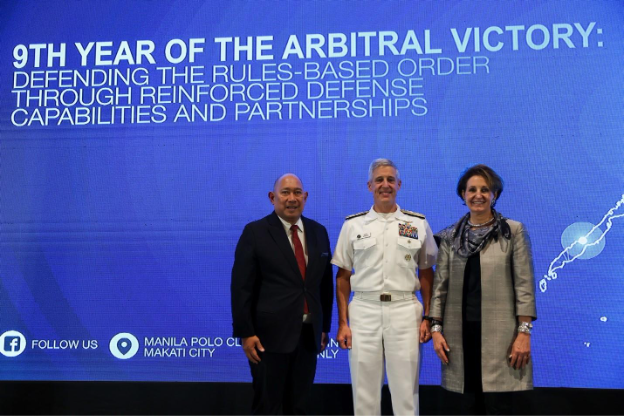
L to R: Prof. Victor Andres “Dindo” Manhit (President, Stratbase Institute), ADM Steve “Web” Koehler (U.S. Pacific Fleet Commander), and H.E. MaryKay Carlson (Ambassador, Embassy of the United States to the Philippines)
I thought I would share just two major trends that I see in the South China Sea, the West Philippine Sea. First, there’s a growing recognition that what happens in the West Philippine Sea is part of a larger regional picture. We can see that China’s unlawful claims to control over the entire South China Sea are linked to its broader push for hegemony in the region.
Just as China has increased its deployments and aggressive tactics in the West Philippine Sea, it has intensified its rehearsals for invasion and blockade of Taiwan. For the U.S. Pacific Fleet, our mission is to deter aggression across the Indo-Pacific together with our allies and partners and to prevail in combat if necessary. That mission of deterrence applies region-wide, including the West Philippine Sea and Taiwan.
A conflict or crisis in either place would endanger the interests of countries across the region who rely on the flow of maritime commerce and put their prosperity at risk. Second, deterrence, despite its challenges, in my opinion, is holding the line in the West Philippine Sea. In the last several years, China has deployed a growing number of vessels to harass and coerce Southeast Asian states in their own waters.
It has used artificial island bases. It has built its springboards for those actions. China’s tactics have also grown steadily and more aggressive with rammings, water cannons, lasers, and sometimes worse.
A year ago, we saw that violence on video at the Second Thomas Shoal where a China Coast Guard used axes and blades to injure a Philippine sailor conducting resupply. But despite these bullied tactics, it’s clear at this ninth anniversary of this arbitral ruling that China has failed to intimidate Southeast Asian claimants into surrendering their sovereign rights. In fact, we’ve seen a lot of the resilience and resolve to defend their maritime rights in the face of mounting pressure.
Nearly all Southeast Asian liberal states are now prioritizing stronger maritime capabilities. Malaysia, Indonesia, and Vietnam have all sustained or expanded their offshore oil and gas work in their South China Sea EEZs. Perhaps the most compelling example, however, is in the Philippines, which has shown in the face of heavy pressure, firm and strong defending of your sovereign rights with dignity and strength. It continues to sustain its garrison of brave Marines at Second Thomas Shoal as an example. The AFP and the Philippine Coast Guard are modernizing their capabilities and deploying proactively to defend their maritime rights. By shining a media light on China’s intimidation tactics at sea, the Philippines has shown public exposure can be a vital tool to blunt coercion.
Its expansion of defense partners has also bolstered defenses, from expanding reciprocal access agreements to inviting a growing range of maritime partners for cooperative patrols and exercises in the West Philippine Sea. The U.S. Navy is proud to be among those partners. Supplementing this Southeast Asian resilience, the actions of the United States, I would argue, have had a real deterrent effect as well.
The U.S. and the U.S. Pacific Fleet, in particular, that was a big bias, but in particular, is privileged to be a friend, partner, and ally with nearly every nation bordering the South China Sea. For our Department of Defense and our Navy, the Indo-Pacific is the priority theater. That is reflected in the strength of our Pacific Fleet.
Over 200 ships, 1,300 aircraft, and 150,000 personnel that’s about 60% of the U.S. Navy and includes our most advanced capabilities. On any given day, around one-third of our units are deployed. Another one-third are combat ready.
Today, there are three Pacific Fleet carrier strike groups deployed, with more preparing for deployment as we speak. The USS George Washington carrier strike group just patrolled the Philippine Sea and finished its visit to Manila. The USS America amphibious readiness group, which is based in Japan, is near Australia right now for the major exercise, Talisman Sabre.
On top of that, we have numerous forward-deployed destroyers, littoral combat ships, submarines, and aircraft that continue to patrol the region. In addition, this strong contribution of allies and partners, many of which are represented here today, has had a powerful cumulative effect on strengthening deterrence. While China has ignored the Arbitral Ruling, the rest of the world has not.
The ruling’s rejection of China’s claim and its endorsement of the Philippines EEZ has become the widely accepted view. It is explicitly endorsed by a growing number of states, especially those who consistently champion freedom of the seas. One of the clearest signs of ally and partner solidarity is the robust series of maritime joint combined exercises across the region.
Those include Balikatan right here in the Philippines. With credit to our Philippine hosts, Balikatan 2025 was the largest ever, with forces from the Philippines, United States, Australia, Japan for the first time, and 16 other nations observing. Multilateral exercises like Balikatan are a reminder that deterrence is a team sport. We are all in need to do our part, and we must continue to build deterrence for the challenges ahead.
So what can we expect in the South China Sea, the West Philippine Sea in this coming year? First, we can expect China to continue to try to divide and pressurize the Philippines and other Southeast Asian countries over the South China Sea. This may come in various forms.
It could be behind-the-scenes coercion to stay silent when China’s ships harass oil and gas or fisheries in other countries’ EEZs. It could mean China offering inducements to buy silence or to look the other way as their Coast Guard or maritime militia assert their control. It might mean sweet words such as, let’s jointly develop your resources.
That are actually an invitation to arrangements that risk implicit recognition of Beijing’s ownership. Claimant states would be wise to compare notes and stay vigilant to these tactics. That will help preserve unfettered access to their sovereign rights and jurisdiction over resources in their EEZs.
You know, second, I think we need to continue to improve our collective ability to deter aggression. We should continue to train and exercise together in meaningful ways. The U.S. Pacific Fleet is always ready to work with you to strengthen deterrence and show no individual country can be pushed around.
As the Secretary of Defense said most recently at the Shangri-La Dialogue, no one should doubt America’s commitment to the Indo-Pacific, allies, and its partners. For proof of that commitment, look no further than the ironclad alliance between the Philippines and the United States. The Philippines is America’s oldest security treaty ally in the Indo-Pacific, since 1951.
And our alliance grows stronger than ever. Today we operate with our Philippine allies as equals. Our alliance has gained dramatic momentum and evolved significantly in the last few years.
Together we are increasing infrastructure investments at agreed sites in the Philippines to support combined training, exercises, interoperability, and disaster response. We’re bringing advanced capabilities and training to the Philippines and deepening our collaboration on defense industry and cyber defense as announced most recently by Secretary Hegseth and Secretary Teodoro in March. This momentum in our alliance is hugely encouraging and the cause is enduring. That cause is freedom. Freedom to safeguard national sovereignty and pursue your people’s prosperity without coercion or threat of force. Earlier today I paid my respects at the Tomb of the Unknown Soldier at the National Hero Cemetery. It stands not far from the Manila American Cemetery where many Americans fallen are laid to rest. It reminded me not only of the shared sacrifice of allies, but of how vital it is to show our resolve to uphold your rights, whether your nation is large or small. For my part and our part in the U.S. Pacific Fleet, we will continue to stand with the Philippines and our other allies to uphold sovereignty and the freedoms we all hold dear.
I truly appreciate and thank everyone for allowing me to be here today, express a couple of my views, and I think this time together has been very important. Thank you very much for the opportunity. Thank you.
 Stratbase Institute