
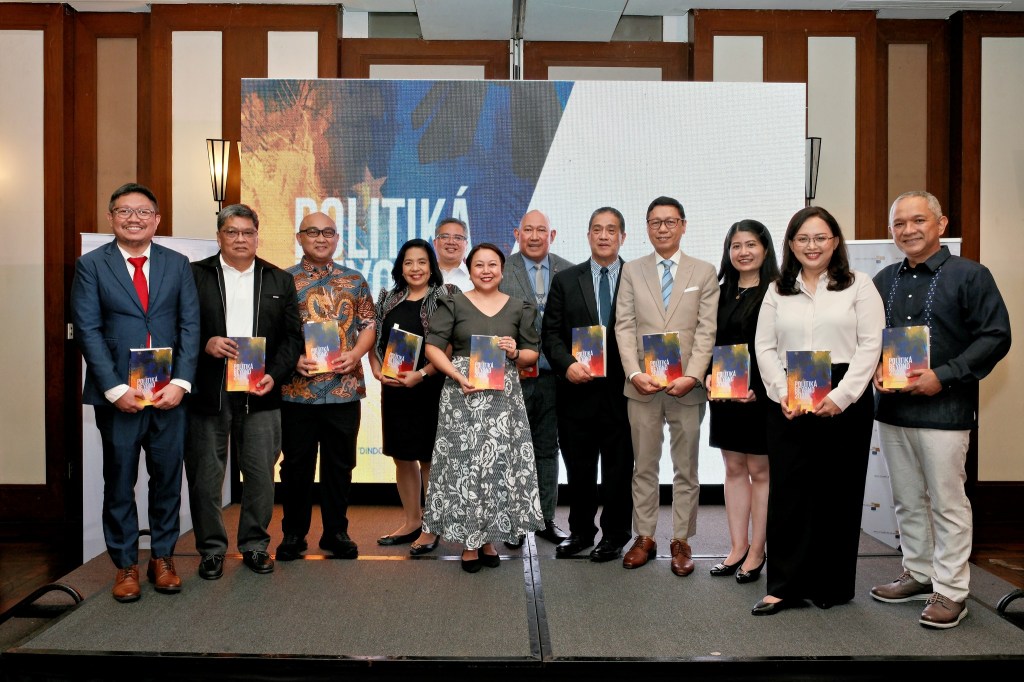
The Stratbase Group unveiled its latest policy book, “Politika Beyond 2028: The Urgency for Resilient Growth, Inclusive Governance, and Geostrategic Thinking,” at the Manila Polo Club. Organized around themes of resilient growth, inclusive governance, and geostrategic thinking, Politika Beyond 2028 examines how economic vulnerability, weak institutions, and external pressures intersect to threaten national stability. It argues that economic strength and governance reform must advance together if the country is to remain competitive and secure.
Edited by Prof. Victor Andres “Dindo” Manhit (Founder and CEO, Stratbase Group), the book brings together special studies authored by Ms. Venice Isabelle Rañosa (Research Director, Stratbase Institute), Asec. Edwin Santiago (Non-Resident Fellow, Stratbase Institute), Dr. Mary Kristerie Baleva (Non-Resident Fellow, Stratbase Institute), Dr. Carmen Lagman (Non-Resident Fellow, Stratbase Institute), Dr. Francisco Magno (Trustee, Stratbase Institute), Mr. Ian Jayson Hecita (Assistant Professorial Lecturer, De La Salle University), RADM Rommel Jude Ong (Non-Resident Fellow, Stratbase Institute), Dr. Renato de Castro (Trustee and Non-Resident Fellow, Stratbase Institute), Dean Jemy Gatdula (Non-Resident Fellow, Stratbase Institute), Usec. Ronald Mendoza (Undersecretary for Strategic Management, Department of Education), Dr. Charmaine Misalucha-Willoughby (Non-Resident Fellow, Stratbase Institute), and Dr. Sherwin Ona (Non-Resident Fellow, Stratbase Institute).
The book launch was attended by key government officials, diplomatic community, military officials, private sector leaders, members of civil society organizations and the academe – all of whom have been Stratbase’s partners through the years. The Philippines can no longer afford short-term thinking. In a world shaped by economic volatility, geopolitical tension, and security threats, we need resilience, good governance, and strategic clarity. Politika Beyond 2028 urges leaders to plan beyond electoral cycles and prepare for long-term risks rather than respond to crises as they emerge.







 Stratbase Institute