The failure of the Duterte Administration’s pivot to the non-traditional partners

On Feb. 24, Russia launched a full-scale armed invasion of Ukraine. The member-states of the Association of Southeast Asian Nations (ASEAN) found themselves confronted with the terrible implications of Russia’s unprovoked aggression in the Ukraine invasion.

The invasion was a blatant violation of an independent state’s sovereignty as enshrined in the United Nations (UN) Charter. Russia’s close partner in East Asia, China, might replicate Russia’s approach in pursuing its irredentist agenda. This could be achieved through its expansion into the South China Sea at the expense of other coastal states and the invasion of Taiwan, which China considers a renegade province. Read More

ADRi vTHD: “Philippine Governance: Lessons and Prospects for the Marcos Jr. Administration”

It appears that the dust has settled as the new administration has taken office and set its priority agenda for its first year. The country recently heard President Ferdinand “Bongbong” Marcos, Jr. give his first State of the Nation Address, with the President concluding that “the state of the nation is sound.”  

The six years of the Rodrigo Duterte administration was indeed a colorful period, to say the least. It was a time marked by strongman rule, local and international criticisms, major infrastructure projects, and a seeming pivot to China despite having an independent foreign policy. Read More

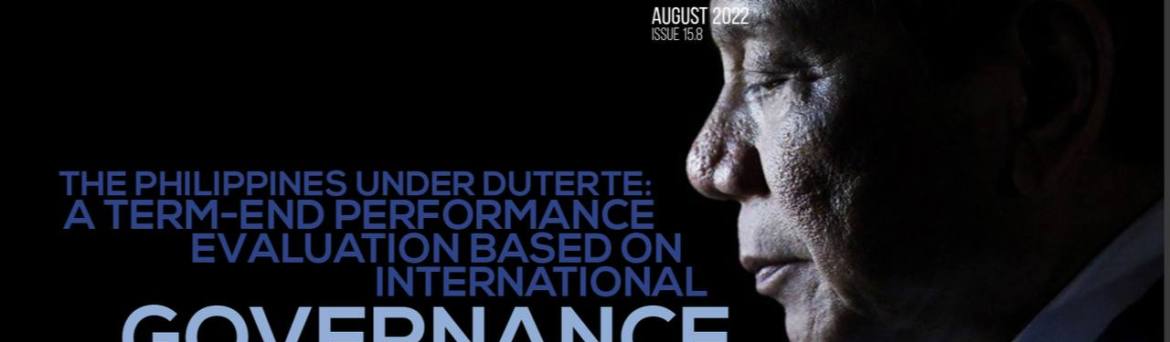
ADRi Occasional Paper: “The Philippines Under Duterte: A Term-End Performance Evaluation Based on International Governance Indicators”

The Stratbase ADR Institute has published its Occasional Paper for the month of August, entitled “The Philippines Under Duterte: A Term-End Performance Evaluation Based on International Governance Indicators,” authored by Mr. Edwin P. Santiago of De La Salle University Manila.

This paper objectively evaluates the six years of the Duterte administration. In explaining whether the administration was a success or a failure, it uses the very same indicators of good governance listed by the National Economic Development Authority, namely: (1) The Worldwide Governance Indicators, (2) Ease of Doing Business, (3) Global Competitiveness Index, (4) Economic Freedom Index, (5) Corruption Perception Index, (6) Rule of Law Index, and (7) Open Budget Index. Read More

Importance of good governance to progress

The medium-term headline goals of the Marcos Jr. administration are very challenging amid the economic scarring caused by the pandemic and the disruptions in the global supply chain and financial system.

With the immediate goal of recovery and regaining the development momentum, a rethinking of economic approaches and how the government could facilitate development points to the strategic importance of investments to our economy and everyday life.

To address joblessness, which currently stands at 6 percent and translates to 2.99 million jobless Filipinos, domestic and foreign investments can fund many projects and support the MSMEs in terms of providing jobs, income, and livelihoods. Read More

Seize the opportunity to be a digital economic power

Moving beyond the crisis entails a wide range of development challenges and opportunities for the Philippines under the President Ferdinand Marcos, Jr. administration.

While the investment-led, export-oriented, manufacturing, and agricultural approaches offer viable and effective solutions to economic problems, digitalization is the critical enabler for recovery and sustainable growth. The use of digital technology offers much more in terms of speed, efficiency, and reach.

Cognizant of the unlimited opportunities at hand, President Marcos Jr., in three of his 19 priority bills, emphasize the need for digital transformation, i.e., the E-Government Act, E-Governance Law, and the Internet Transactions Act. Read More

A new chapter in PHL foreign relations

“A friend to all and an enemy to none” was the phrase used by President Ferdinand “Bongbong” Marcos, Jr.  to define his independent foreign policy. To a large extent, this signifies continuity with reference to past presidents’ standpoint, domestically and internationally.

Change, however, lies on the dynamics involved in operationalizing the policy amid the ever-changing global environment of interconnectedness and uncertainty. Read More