ADRi vTHD: “The Future of Philippine Foreign Policy”

The rising uncertainties in the global environment, especially in the Indo-Pacific region, has demanded states to reorient its foreign and security policy to identify where and whom to collaborate, cooperate, compete, and confront in terms of emerging threats and opportunities for development. Within the context of maritime security, the Philippines continues to be in the mix of geopolitical shifts given the increasing influence of China and the country’s territorial rights over the West Philippine Sea. As the country moves into a new administration, a future-oriented, responsive, and strategic Philippine foreign policy must entail the configuration of the country’s national interest vis-à-vis the uncertainties about the current international order and lessons learned from the Duterte administration. The country must strengthen its inherent capability to be a maritime power given its strategic geographic characteristics and location from being a center of international trade flow and marine resource abundance.   Read More

Governance beyond the crisis

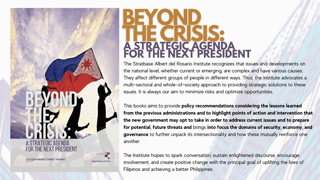
The next six years will be crucial for Philippine society as it struggles to recover from the pandemic, build back better from the experiences and performances of the outgoing administration, and craft the future of our country. Cognizant of the extant and emerging challenges that the Filipino nation confronts, Stratbase ADR Institute launched its book “Beyond the Crisis: A Strategic Agenda for the Next President” last May 20. A veritable collection of 16 special policy papers, the institute proposes to the next government sensible and actionable recommendations in the areas of foreign policy and security, economy, social inequality, food security, climate change, and governance. Read More

The Marcos presidency and the future of Philippine foreign policy

After one of the most consequential national elections in the country’s history, Ferdinand “Bongbong” Marcos, Jr. is set to become the 17th president of the Philippines through a majority vote. Thirty-six years after being forced into exile in the United States, his family’s return to power holds significant implications for the country’s foreign policy. The presidency of Bongbong Marcos is expected to face complex and multifaceted challenges brought by heightened geopolitical risks and power shifts in the region. His call for “unity,” conveyed throughout the campaign period, will also be tested against circumstances on the ground, especially on critical issues such as the territorial and maritime disputes in the West Philippine Sea. Read More

Legitimation challenges

With a contentious family history, presumptive President Ferdinand “Bongbong” Marcos Jr. faces an uphill battle in establishing his credibility as a leader. He said we should judge him by his actions — not by his family’s past. Let’s take him up on this challenge. How will we do this? First, we will look at whether he is getting the basics right. Is he addressing the issues that matter? What is he doing to achieve his campaign promises and policy pronouncements? Read More

Vote Right 2022: The Luzon Leg

The Stratbase ADR Institute, in partnership with Democracy Watch Philippines, conducted the final leg of the Vote Right 2022 Voter Education series last 2 May 2022. Entitled “Vote Right 2022: The Luzon Leg,” this final voter education forum leading up to the elections provided a space to remind students and voters as a whole of their responsibility to uphold democracy through casting their ballots. Read More