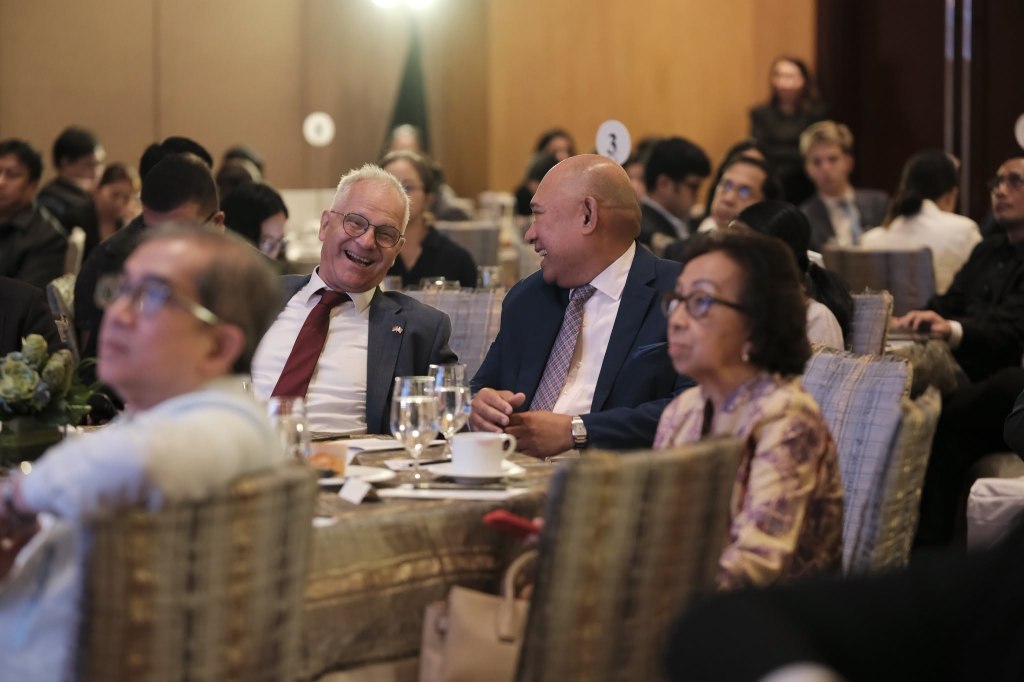
The Stratbase Institute, in partnership with the Embassy of the Federal Republic of Germany in the Philippines, organized a high-level conference entitled “Towards a Peaceful and Sustainable Future: Addressing Climate Security in ASEAN” at Fairmont Hotel, Makati City. The event brought together key stakeholders from government, the private sector, diplomatic missions, academe, and civil society to examine the security implications of climate change, explore policy responses to strengthen climate resilience, and identify opportunities to advance regional cooperation under the Philippines’ ASEAN Chairship.
In his opening remarks, H.E. Andreas Michael Pfaffernoschke, Ambassador of the Federal Republic of Germany to the Philippines, underscored the importance of understanding the climate-conflict nexus. He outlined five priorities for ASEAN: making prevention the organizing principle; ensuring that climate adaptation is conflict-sensitive; placing vulnerable communities at the center of climate-security policies; strengthening regional cooperation on shared resources; and connecting peacebuilding with climate finance. He stressed the need to move beyond treating climate change solely as an environmental issue, conflict as a security issue, and development as an economic issue, stressing that these are interconnected dimensions that require equally integrated responses.
In his keynote message, Department of Environment and Natural Resources Secretary Juan Miguel Cuna stressed that climate change acts as a threat multiplier and that environmental resilience must be regarded as fundamental to national security. He emphasized that climate resilience must increasingly become part of ASEAN’s regional security architecture and that there must be a recognition that regional peace and prosperity depend on the collective ability of Member States to anticipate and manage climate risks.
Echoing this, Special Envoy for Disaster Risk Reduction and Management Maria Antonia Yulo-Loyzaga stressed that climate change presents a convergent risk arising from the intersection of environmental hazards and socio-cultural, economic, and geopolitical change. She further emphasized that regional solutions must have local roots and that stronger climate security ultimately depends on resilient communities effective local action and sustained social cohesion.
In his closing remarks, Stratbase Institute President Prof. Victor Andres “Dindo” Manhit emphasized that, given the transboundary and increasingly complex nature of climate-related challenges, no nation can stand alone. Strategic partnerships and alignment will remain essential to strengthening climate security and resilience. For the Philippines and all ASEAN Member States, he stressed the importance of harnessing meaningful partnerships with like-minded countries such as Germany to strengthen collective resilience.
The Stratbase Institute remains committed to supporting efforts to strengthen climate security and regional resilience as the Philippines advances its ASEAN Chairship, while continuing to work with like-minded partners such as Germany to promote sustained cooperation and concrete action on shared climate-security challenges.